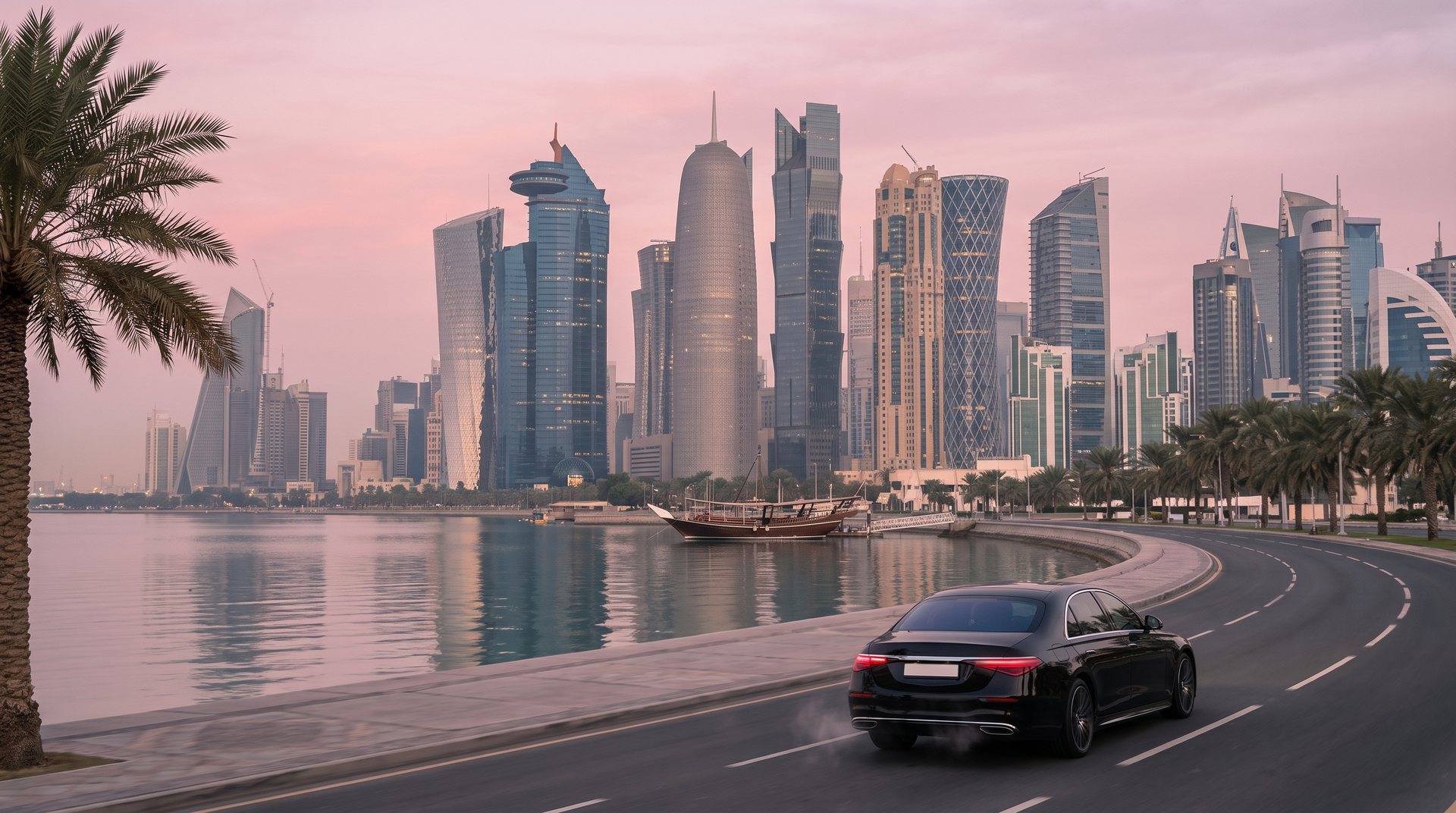
Doha. West Bay fifteen to twenty five minutes from the aircraft, and the car held all day.
Doha's roads are wide, modern and well behaved, so the distance is rarely the issue. We plan the day around what does matter here: the hour, the heat and the time of year.
At a glance
What you need to know
- The airportHamad International (DOH)On the coast immediately east of the city. Two parallel runways, the longer of them 4,850 metres, so no business jet category is limited by the field itself.
- The private jet terminalOn the airport, away from the main hallsHamad International has a dedicated private jet terminal with its own arrival, immigration and apron access, operated by Qatar Executive. See the Doha private terminals page for the handling detail.
- From LondonAround 6 hours 30 to 7 hours 30 nonstopComfortably inside the range of a heavy or ultra long range aircraft. A super midsize will often do it too, depending on the winds and how many of you there are.
- On the roadDrives on the rightWide, modern, well signed and firmly enforced. The peaks are roughly 07:00 to 09:00 and 16:00 to 19:00, and they are the only thing that reliably costs you time.
Checked in September 2026. Airspace and handling arrangements across the region can change at short notice, so we confirm the current position for your dates, along with the relevant government travel advice, before anything is committed.
Flying in
One airport does almost everything
Hamad International is the answer for nearly every private flight into Qatar. It is a large, modern airport built to handle the biggest aircraft flying, which means the field never dictates the aircraft you charter, and it sits on the coast just east of the city rather than out in the desert. Private arrivals use a dedicated terminal on the airport, separate from the main passenger buildings, with its own immigration and direct access to the apron, and passengers are usually in the car within fifteen to twenty minutes of the doors opening.
The old Doha International Airport is still there, about five kilometres west of Hamad, and it still flies: the Amiri Flight, the air force, helicopter operations and some general aviation work from it. It is not the field a visiting charter would normally plan around, and access to it is not a given. If someone suggests it to you, ask why before you agree, because the terminal and the handling at Hamad are better in almost every case that matters to a passenger.
What changes a Doha plan is rarely the aeroplane, since the sector from London is well within the reach of the categories most clients use for the Gulf. It is aircraft parking in a busy conference week, the timing of your first meeting against the morning peak, and whether the region is settled. We look at all three before we quote rather than after.
Journey times
From West Bay by road
| To | Quiet roads | Busy periods |
|---|---|---|
| Hamad International (DOH) | 15 to 25 minutes | 30 to 45 minutes |
| Msheireb and the old town | 10 to 15 minutes | 20 to 30 minutes |
| Katara and The Pearl | 10 to 20 minutes | 25 to 40 minutes |
| Lusail and the marina | 15 to 25 minutes | 30 to 45 minutes |
| Education City and Al Rayyan | 20 to 30 minutes | 35 to 55 minutes |
| Al Wakrah and the south | 30 to 40 minutes | 45 to 65 minutes |
| The inland sea and the southern desert | 1 hour 15 to 1 hour 45 | Sand and the last few miles decide it, not traffic |
| The northern tip and Al Ruwais | 1 hour 15 to 1 hour 30 | Much the same all day |
Realistic ranges, not promises. Our own cars and chauffeurs are in London and Manchester, and a trusted global network covers everywhere else. Here cars are arranged through operators we know, and you still deal with one contact at Odyssey.
Driving here
An easy city to drive, in a climate that is not
Qatar drives on the right, and Doha is one of the simpler Gulf cities to move around. The road network is new, the expressways are generous and the city is compact: almost everything a visitor needs sits in a crescent running north from the old town at Msheireb, along the Corniche to the towers of West Bay, then up the Lusail Expressway past Katara, The Pearl and into Lusail. That single spine carries most of the traffic that matters, and it is the road that clogs in the peaks. The interchanges are the pinch points rather than the straights, and a driver who knows which one to avoid at half past five saves you more time than any amount of speed.
There is a metro, and it is good. Three lines meet at Msheireb, and the Red line runs from Lusail through West Bay all the way to the airport. It is worth knowing about, and it is worth knowing that it will not run your day for you: the meetings, the villas and the compounds that clients actually visit are spread across districts the metro only brushes, and the walk at either end is the problem.
That walk is the real point about Doha. For most of the year the climate makes short distances expensive. From June to September the afternoons run well above 40 degrees and July and August add heavy humidity on top, which turns two hundred metres of pavement in a suit into something nobody wants before a meeting. This is why a car standing and waiting is the normal arrangement here rather than a luxury, and why the difference between a good day and a poor one is often a chauffeur who has established in advance which door of the tower has covered access.
What people book
How Doha is usually run
- A car at the private jet terminal at Hamad International, with the chauffeur tracking the aircraft rather than a filed time, covered on private jet transfers
- A chauffeur at your disposal for the day, because in this climate the waiting between appointments is most of the job
- Fund, bank and sovereign wealth meetings across West Bay and Lusail, where four or five people move on slightly different schedules and the cars shadow them, covered on executive roadshows
- Conference weeks at the exhibition centre, with a run order agreed the night before and setting down points fixed in advance
- Family arrivals met at the terminal and taken straight to the hotel or the compound, with a second vehicle for the cases
- Group travel in a V-Class when there are six of you and luggage, which is also the easiest vehicle for hotel and tower driveways here
The calendar
Six good months, and a summer to plan around
The season is long and clearly defined. From November to March the weather is genuinely pleasant, mild and sunny through December, January and February, and that is when the business diary, the conference programme and the sport all sit. It is also when hotels, cars and drivers are tightest. Summer is the opposite: from June to September the heat is severe, a great deal of the city's social life moves indoors or abroad, and anyone who can choose their dates chooses not to be here. April, May and October are workable shoulder months, warm rather than punishing.
Two fixtures are worth putting in the diary early. Web Summit Qatar runs from 31 January to 3 February 2027 at the Doha Exhibition and Convention Centre in West Bay, and brings tens of thousands of people into a small number of streets. The Doha Forum takes over the diplomatic end of the city in early December each year, with the motorcades and short notice road closures that come with it. Both weeks commit the good cars and the good drivers months ahead.
Ramadan falls from around 7 February to 8 March in 2027, and it changes the working day rather than stopping it. Office hours shorten, a great deal of business moves to the evening, and the roads have a distinct and heavy rush in the half hour before sunset that catches visitors out every year. If your trip falls inside it, tell us, and we will build the day around the evening rather than against it.
Around the trip
Related pages
Airports and aircraft
Elsewhere in the region and beyond
Who we look after here
Request a quote
Tell us the dates and the diary
Dates, how many of you, where you need to be and when. We come back with aircraft options for the sector, the cars on the ground, an honest view of what that week will do to the roads, and the current position on airspace and handling.
Prefer to talk? +44 2030 048300 or WhatsApp, at any hour.
Questions people ask
About Doha
Which airport do private flights use?
Hamad International, almost always. It has a dedicated private jet terminal with its own immigration and apron access, and it takes every category of business aircraft. The old Doha International Airport still operates, but it is not the field a visiting charter would normally plan around.
Can we fly London to Doha without a stop?
Yes. It is around six and a half to seven and a half hours, which a heavy or ultra long range aircraft does easily and a super midsize will often manage depending on the winds and the load. We settle the category against your passenger numbers and your departure time.
What happens if airspace or routings change at short notice?
We watch it and we tell you. Regional airspace can close or reroute with little warning, so we confirm the position for your dates before anything is committed, and we keep the ground arrangements flexible enough to absorb a changed arrival time rather than fail on it.
Are these your own cars?
Our own chauffeurs and cars are in London and Manchester, and a trusted global network covers everywhere else. In Qatar we arrange them through operators we know and run them to the same standards, with one contact at Odyssey from your front door onwards.
Is it worth visiting in the summer?
Only if the dates are fixed for you. From June to September the afternoons are well above 40 degrees and July and August are humid with it. It is entirely manageable with the right arrangements, but it changes how a day is built and how much walking anyone will tolerate.

We deal with problems before you know they exist