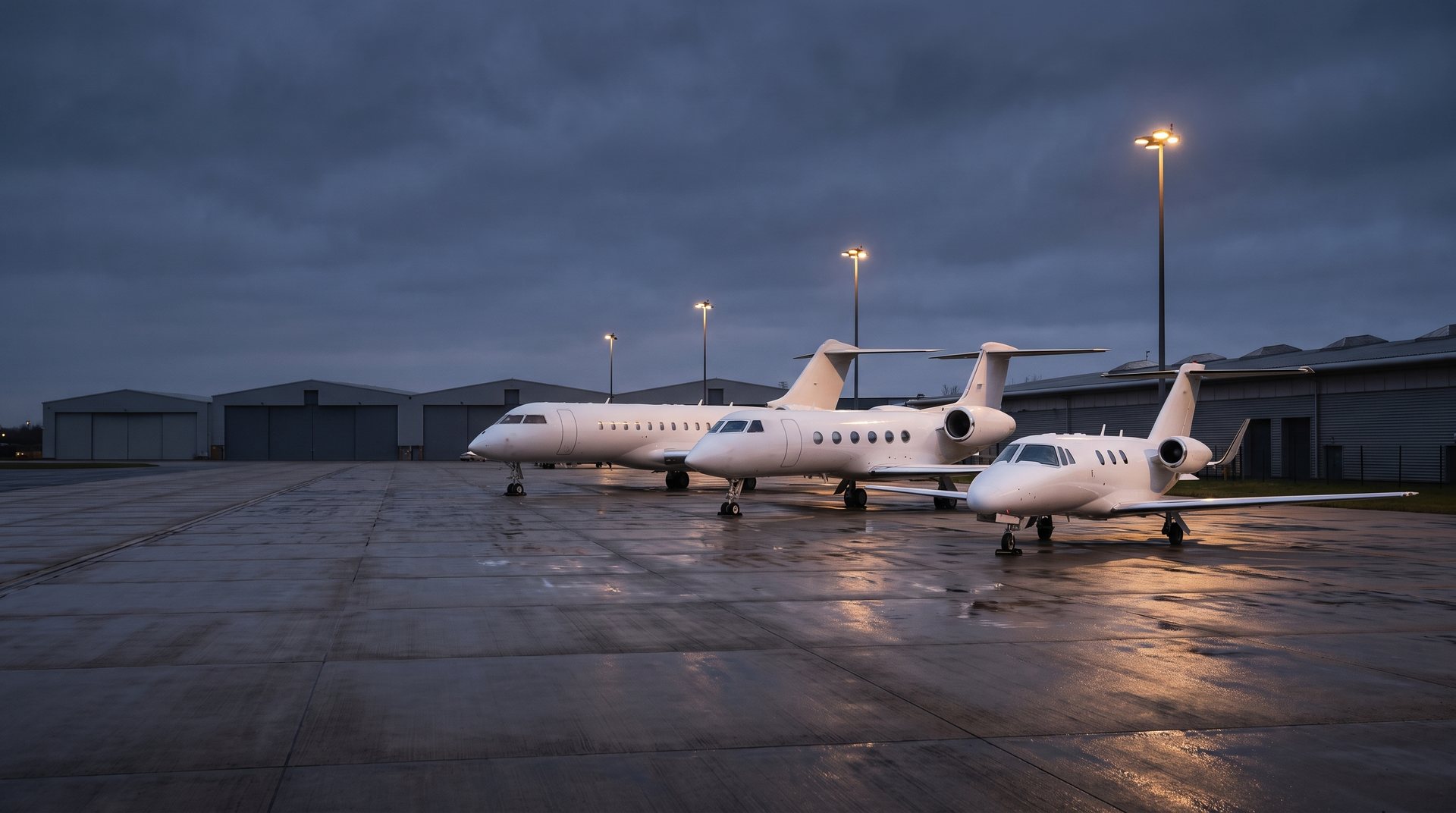
Choosing the right jet category. Three questions settle it, and only one of them is about the aircraft.
Most people choosing a charter for the first time start with the aeroplane. The people who do this every week start with the luggage, then the runway, then the sector, and let those three things choose the aeroplane for them.
Where to start
People, bags and the sector
Every charter conversation we have begins with the same three numbers. How many of you are travelling, what you are bringing, and how far the longest leg is. Those settle the category almost every time, and everything else is a refinement within a class rather than a choice between classes: the interior, the age of the aircraft, whether there is a cabin attendant.
The reason the order matters is that seats and baggage run out at different points. Aircraft are certified for a number of passengers that the hold very often cannot support, and a light jet certified for seven is a five person aircraft the moment those five bring hard cases. The number that counts is not how many people can sit down; it is how many people can sit down with what they are actually carrying.
Odyssey arranges aircraft, so the categories below are guidance rather than a list of what we have standing outside. When we quote, the specific aircraft, its cabin layout and its real hold volume are confirmed for you before anything is agreed. What follows is the map of the territory.
The classes
What each category actually does
| Category | Passengers | Typical range | What it is really for |
|---|---|---|---|
| Turboprops | 6 to 9, comfortably 6 to 8 | Roughly 1,000 to 1,800 nautical miles | Short, steep, high or unpaved runways. Fields a jet cannot use, and a cargo door that swallows skis and equipment. |
| Very light jets | 4 to 5, comfortably 4 | Roughly 1,100 to 1,500 nautical miles | Two or three people with soft bags on a short hop. The smallest hold in private aviation and the biggest source of surprises. |
| Light jets | 5 to 7 | Roughly 1,500 to 2,000 nautical miles | London to almost anywhere in western Europe. The workhorse of the European charter market. See the Phenom 300. |
| Midsize jets | 7 to 9, eight in comfort | Roughly 2,000 to 3,000 nautical miles | The whole Mediterranean, the Canaries, North Africa and Scandinavia, with a case each. See the Citation XLS. |
| Super-midsize jets | 8 to 10, nine in comfort | Roughly 3,200 to 4,000 nautical miles | Standing headroom and a hold that copes with sports luggage. London to Dubai. See the Challenger 350. |
| Heavy jets | 10 to 16, twelve in comfort | Roughly 3,900 to 5,200 nautical miles | Transatlantic, the Gulf and much of India, in separate cabin zones with a flight attendant. See the Global 6000. |
| Ultra-long-range jets | 12 to 16 | Roughly 6,000 to 7,700 nautical miles | Most of the world from London without stopping, with a bedroom and a shower on the largest. See the G650. |
| VIP airliners | From about 19 upwards | Roughly 3,000 to 6,700 nautical miles | Squads, tours and delegations, and a hold built for freight rather than suitcases. |
Every figure here is a category range rather than a specific aircraft. Individual types vary considerably within a class, and two aircraft of the same type can differ in seats, hold and range depending on how they were specified.
The number that misleads
Published range is a best case, not a promise
A brochure range assumes a particular number of passengers, a particular fuel load, still air and a long runway at sea level. Fill every seat, load the hold, add a winter headwind across the Atlantic, and the honest figure is meaningfully shorter. On a westbound transatlantic sector in January this is not a technicality: it is the difference between flying to New York and stopping in Ireland or the Azores on the way.
Hot weather and high airfields do the same thing to take-off performance. An aircraft that will lift a full load out of Luton on a cold morning may need to leave fuel or passengers behind at an alpine field in August. This is why an operator will sometimes propose a larger aircraft than the seat count suggests, and it is usually a good reason rather than an upsell. Ask for the reason and you will get it.
The practical rule is to give whoever is quoting the full picture: every passenger, every bag, the time of year and the actual airfields, including the return. A quotation built on four passengers and a weekend bag does not survive a fifth person and a set of golf clubs appearing on the Thursday. See how private jet charter works and the cost guide for what else moves a quotation.
Trip calculator
Try it on your own trip
Put in the two ends of a trip you make. The calculator applies the rule in this guide: the published range, less a margin for reserves, wind and load, then shows which categories fly it without a stop.
Distances are great circle, the shortest line over the earth. Non-stop is judged against 85% of each aircraft's published still-air range, which leaves a sensible margin for reserves, wind and load. Times are a planning range for the time in the air, not a schedule. Aircraft are arranged with licensed commercial operators, and every quote is checked against the actual aircraft, the load and the forecast for your date.
The luggage question
The thing that changes the aircraft
More charters are upgraded for baggage than for range or for seats. Say all of this at the first conversation and it never becomes a problem at the aircraft steps.
- Hard cases take far more hold volume than soft bags of the same capacity. On the smaller classes this alone can decide the aircraft
- Skis, snowboards and boot bags need length as well as volume, and not every hold will take them. Ski season charters are quoted around the skis, not around the people
- Golf bags are the most common upgrade trigger of the summer. Four sets of clubs is a different aircraft from four people
- Pushchairs, travel cots and car seats are bulky, awkward and often forgotten in the count. Tell us about the children's equipment as well as the children
- Instruments, camera kit, samples and equipment cases may need to be secured in the cabin rather than the hold, which affects the seat count
- Pets travel in the cabin on most private charters, and the operator, the aircraft and the destination all have a say. See pet travel
- On a return trip, remember what you are bringing back. Shopping, gifts and a case bought en route are a real and regular cause of a difficult departure
The airport constraint
Sometimes the runway chooses the aircraft
A number of the destinations our clients most want to reach have airfields that simply refuse the obvious aircraft. Samedan for St Moritz sits high in the Engadine and is demanding in both performance and weather. Sion and Chambery serve the Alps with approaches that require specific crew qualification and turn difficult quickly in winter. St Barths takes only small aircraft onto a very short runway, which is why almost everybody arrives from a neighbouring island.
In those cases the sequence reverses: the airfield decides the category, and the category decides how many of you can travel and what you can bring. A turboprop or a very light jet into the mountain field, or a larger aircraft into the valley airport with a road or helicopter transfer for the last part, are the two honest answers, and which is better depends on the party and the weather far more than on preference. Our ski destinations and alpine airport pages set the options out field by field.
The same logic applies at the London end. London City requires specific aircraft and operator approval for its steep approach, which excludes a good deal of the fleet, and Northolt works by slot and permission. Our guide to London's private terminals compares all seven fields on drive times and constraints.
Briefing us
What to send in the first message
- 01
The route and the times that matter
Departure and destination airfields if you know them, and the latest useful arrival time rather than a departure time. It gives us far more ways to solve the problem.
- 02
The real passenger count, including children
Children take seats and their equipment takes hold space. An accurate number now is better than a tidy one, because a late addition can change the aircraft.
- 03
Everything you are carrying
Bags by type, sports equipment, instruments, pushchairs, pets. This is the single most useful thing you can tell us, and the thing most often left until the day.
- 04
Anything that is not negotiable
A cabin attendant, a bed on a long sector, a particular airport, Wi-Fi that genuinely works, or a budget. Tell us which of those is the hard one and we will build around it.
The other half
The aircraft is the middle of the journey, not the whole of it
A well chosen aircraft into the wrong airfield can cost you the hour it saved. We quote the cars at both ends alongside the flight, timed to the tail number rather than to a schedule, so you can compare door to door rather than wheels up to wheels down.
Questions people ask
About choosing a category
Is a bigger aircraft always better?
No. A larger aircraft costs more, needs more runway and is not faster on a short sector. The right answer is the smallest class that takes your party, your luggage and your route comfortably, with a margin for the weather.
Why has the operator proposed something larger than I asked for?
Usually performance. A hot day, a short or high runway, a full cabin or a winter headwind can put a sector beyond the class you expected. Ask for the reason, and a good operator will explain it in a sentence.
Can we stop to refuel instead of taking a larger aircraft?
Often, and on some routes it is the sensible economy. A technical stop adds roughly an hour on the ground and is barely noticed on a long sector, though it suits some passengers much less than others.
How many bags can we take?
It depends on the hold of the specific aircraft rather than on the class, and on whether they are soft or hard. Tell us what you have and we will tell you what it needs before anything is confirmed.
What about very short hops?
Under about an hour, a helicopter is often the better tool, particularly for a city to city leg or the last part of an alpine journey. See helicopter charter.
Can we look at empty legs in a class above?
Yes, and it is one of the better ways to travel in a bigger cabin. The catch is flexibility. See are empty legs worth it.
Request a quote
Tell us the people, the bags and the route
Send the route, the dates, the real passenger count and everything you are carrying, and we will come back with the categories that genuinely fit and the reasons, along with the cars at both ends. Nothing is booked or charged online.
Prefer to talk? +44 2030 048300 or WhatsApp, at any hour.

One contact, wherever you are