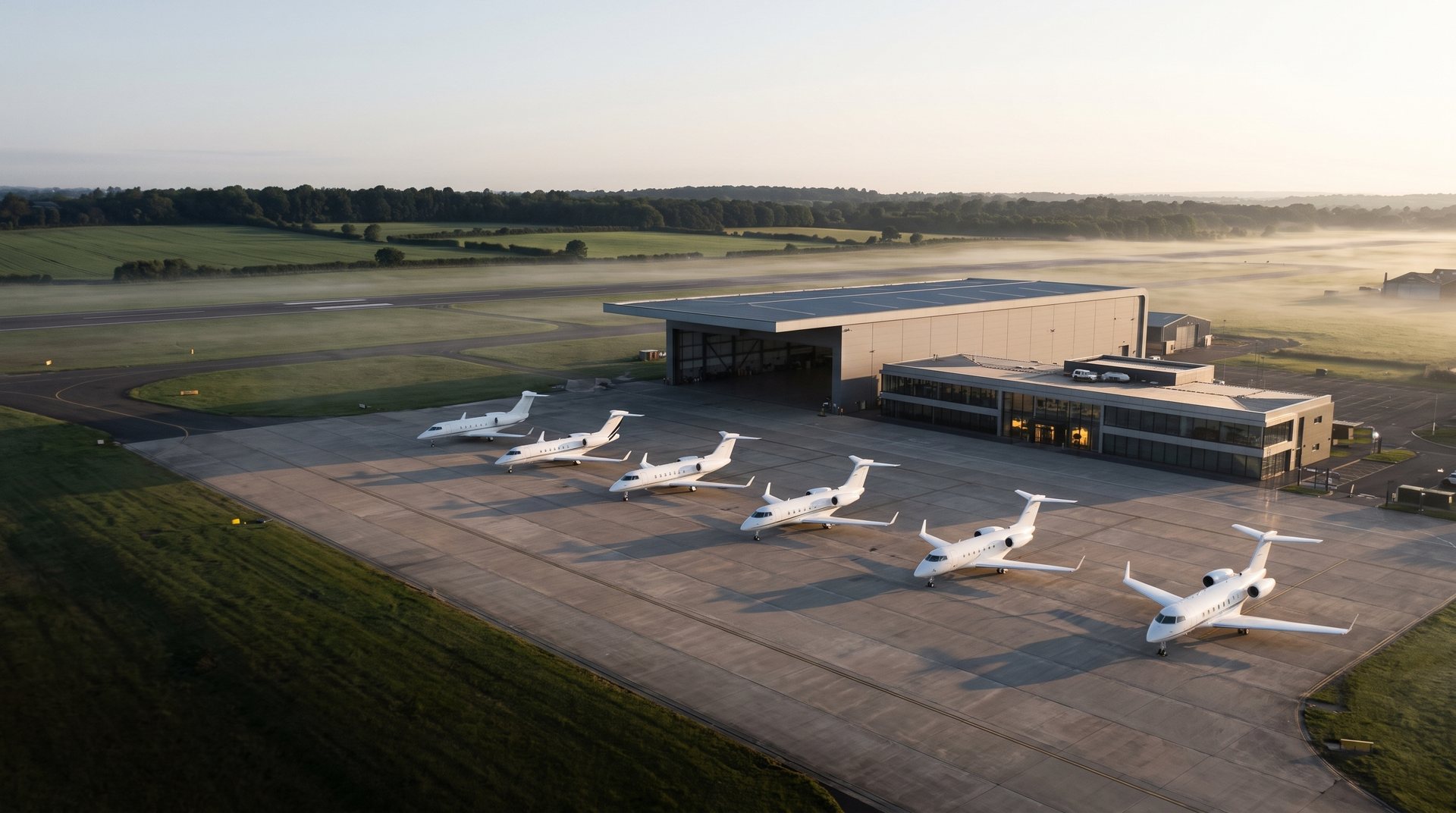
Seven private jet airports around London. The one that suits you depends on where you are going, not on the map.
London is served by more business aviation airports than any comparable city, and the differences between them are larger than they look. Hours, runway length, permission requirements and, above all, the drive at the far end decide which is right.
The point people miss
The flight is short. The drive is not
Choosing between London's private airfields is almost always presented as an aviation decision, and it is usually a road decision. The difference in flight time between two of these fields is a handful of minutes. The difference in drive time at the far end, on a Thursday evening in November, can be an hour and a half. If you are flying in from Nice, that hour and a half is a quarter of your door to door journey.
The operator will normally propose an airport based on where the aircraft is, what the runway needs to be and whether the hours work. That is the right basis for their half of the question. The half that belongs to you, or to whoever holds the diary, is which field puts you nearest the thing you came for, at the hour you will actually be driving. Those two answers do not always agree, and the conversation is worth having before the flight is confirmed rather than afterwards.
Every journey time below is a realistic range rather than a promise, taken from our own airport pages and given for quiet roads first and busy periods second. Our chauffeurs meet aircraft at all of these fields; our office is on the airfield at Luton, in Hangar 7-8 on Percival Way.
The comparison
Drive times into London, and what each field is really for
| Airport | Mayfair and the West End | The City and Canary Wharf | What it is best at |
|---|---|---|---|
| Northolt | 30 to 40 minutes, 45 to 70 at peak | City 45 to 60, Canary Wharf 55 to 70 | The closest field to the West End by a clear margin. Permission and slot only, and an active RAF station. |
| London City | 30 to 45 minutes, 45 to 75 at peak | Canary Wharf 10 to 20, City 20 to 30 | The right field for the Docklands and the City. A steep approach limits the aircraft, and a weekend curfew limits the days. |
| Biggin Hill | 55 to 75 minutes, 75 to 110 at peak | City 50 to 65, Canary Wharf 45 to 60 | Inside the M25, calm and quick on the ground, and the natural field for south London, Kent and Sussex. |
| Luton | 55 to 70 minutes, 75 to 110 at peak | City 60 to 75 | The busiest London base for business jets, two private terminals, long hours and a straight run down the M1. |
| Farnborough | 60 to 75 minutes, 80 to 120 at peak | City 75 to 90 | Business aviation only, and the right answer for Ascot, Windsor, Surrey and the Thames Valley. |
| Stansted | 65 to 85 minutes, 90 to 130 at peak | City 55 to 70, Canary Wharf 60 to 75 | The long runway. Heavy and ultra-long-range aircraft, transatlantic departures, hangarage and no hours problem. |
| Oxford | 80 to 105 minutes, up to 150 at peak | Not a sensible pairing | Oxford, the north Cotswolds, Bicester and Silverstone. For central London it is the wrong airport. |
Ranges, not promises. The pattern to notice is that the order changes depending on the destination: the best field for Mayfair is close to the worst for Canary Wharf, and the reverse is also true. We plan each journey for the hour you are actually travelling.
The two shortest drives
Northolt and London City, and what they ask in return
Northolt is an active Royal Air Force station in west London that accepts civil business flights alongside military and government movements, which take priority. Access is by slot and prior permission, applied for by your operator and granted at the station's discretion, and there is a long-standing annual ceiling on civil movements. Civil handling is through a single appointed agent, and there is a gate procedure for passengers and drivers that takes a few minutes and cannot be hurried. See handling at Northolt.
In exchange you get an aircraft parked a dozen or so miles from Hyde Park on the right side of the city, with no motorway ring to cross. On a good morning that is a thirty minute drive to Park Lane. For a client whose whole trip is in the West End, nothing else comes close, and it is also strong for Windsor and Ascot and for a connection at Heathrow.
London City is the only airport inside London itself with a purpose-built private terminal, the Jet Centre, and it is three miles from Canary Wharf and five from the City. The catches are real. The approach is steep enough to require specific aircraft and operator approval, which rules out a good deal of the fleet, and flights are not permitted from half past twelve on Saturday until half past twelve on Sunday. If your aircraft is cleared and your weekend fits, it is the quickest exit from an aircraft to a desk anywhere in Britain.
The workhorses
Luton, Farnborough and Biggin Hill
Luton handles a large share of London's private flights and has two private terminals, Harrods Aviation and Signature, on opposite sides of the field. Long hours, a straight run down the M1 and a deep pool of based aircraft make it the default for a great many trips, and it is where Odyssey Connections began. Being based on the airfield means our chauffeurs are minutes from either terminal when a slot moves, rather than an hour away in London.
Farnborough is the only airport in the country dedicated entirely to business aviation, with a single terminal run by the airport itself and no airline traffic at all. Published hours are 07:00 to 22:00 on weekdays and 08:00 to 20:00 at weekends and on bank holidays, which is worth checking against a late arrival. For Ascot, Sunningdale, Wentworth and Surrey it is 25 to 35 minutes and obviously right; for the West End it is a long drive that people underestimate. See the Farnborough terminal.
Biggin Hill sits inside the M25 in the London Borough of Bromley, takes no airline flights, and has two private terminals, Biggin Hill Executive Handling and Jetex. It is close in miles and slow in traffic, because there is no motorway into central London from the south east. For the City, Canary Wharf, Kent and Sussex it is excellent. For the West End at five o'clock it is not, and the answer there is often the helicopter shuttle to the London Heliport at Battersea, about six minutes in the air, with a car waiting at the other end.
The long runway and the country field
Stansted and Oxford, for two different reasons
Stansted is where you go when the aircraft is the constraint. The runway takes anything, the hours are not a problem, and a great many long-range aircraft are based and hangared there, which is why a client whose jet lives at Stansted will use it even when another field is nearer the meeting. Several handling companies operate on the field, including Harrods Aviation and Inflite The Jet Centre; our Stansted private terminals page sets out who is where. The practical warning is geography: the private terminals sit away from the passenger terminal on their own access roads, and a car sent to the wrong side of the field is twenty minutes from the right one. We confirm the terminal against the tail number before the day.
London Oxford at Kidlington is a different proposition altogether, and it is on this list because people keep trying to use it for London. It is roughly sixty miles out, with the drive to town running past 80 minutes on quiet roads and considerably more at peak. What it is genuinely excellent at is Oxford itself, the Cotswolds, Bicester, Silverstone and the colleges. Arrivals need prior permission and published hours are 06:30 to 22:30. See the Oxford executive terminal.
Two fields are missing from the comparison deliberately. Heathrow accepts business aircraft and has a dedicated private suite for passengers on scheduled flights, but slots are scarce and expensive and it is rarely the sensible choice for a private movement. Gatwick, with Signature on the field, works well for Sussex and the south but is a long way from anywhere in London.
Choosing
How to decide in five minutes
Work backwards from the destination and the hour, not forwards from the aircraft.
- Name the actual address you are going to and the time you need to be there, and let that pick the field rather than the other way round
- Check the aircraft first if the field is London City, because a steep approach approval or a weekend curfew will settle the question before anything else does
- If the trip is a same-day return to the City or Canary Wharf, London City usually beats everything, and Biggin Hill is the fallback
- If the aircraft is heavy or the sector is transatlantic, expect Stansted, and plan the road leg accordingly rather than being surprised by it
- If any part of the day is in Ascot, Windsor or Surrey, Farnborough will almost always win despite the mileage
- Ask your operator what the field costs in landing and handling as well as what it costs in time. The two rarely point the same way
- Tell us the tail number and the handling agent as soon as you have them, and tell us the moment either changes
The ground half
We meet aircraft at all seven
Cars are timed to the tail number rather than to a schedule, the arrival is watched by an operations desk, and the terminal is confirmed with the handling agent before the day. Our own cars and employed chauffeurs are in London and Manchester, and at the far end of the flight we arrange cars through operators we know.
Questions people ask
About choosing a London field
Which is the fastest into central London?
Northolt for the West End, London City for the City and Canary Wharf. Both come with conditions, so the honest answer for many trips is Luton or Biggin Hill, which take any aircraft on any day.
Can I change airports after the flight is booked?
Sometimes, and it depends on slots, handling, crew hours and whether the aircraft has somewhere to park. Ask early. Changing the car is easy; changing the aeroplane is not.
Why does my operator keep proposing Stansted?
Usually because the aircraft is based or hangared there, or because the runway or the hours suit the sector. It is a good answer for the flight, and worth checking against your destination on the ground.
Do you charge extra to meet a delayed flight?
Tell us the tail number and we watch the aircraft rather than the clock. What happens to waiting time on a long delay is set out in your quotation before you travel, never added afterwards.
Can the car come to the aircraft?
At several of these fields, where the terminal and that day's arrangements permit it. It is never automatic and it is always agreed in advance with the handling agent.
What about helicopters?
A helicopter transfer from Biggin Hill to Battersea takes about six minutes and can save the better part of an hour at a bad time of day. See helicopter charter.
Tell us the tail number
We will meet you at any of them
Give us the airport, the handling agent, the tail number and where you are going, and we will tell you what the drive really looks like at that hour before you fix the flight. Nothing is booked or charged online.
Prefer to talk? +44 2030 048300 or WhatsApp, at any hour.
We deal with problems before you know they exist