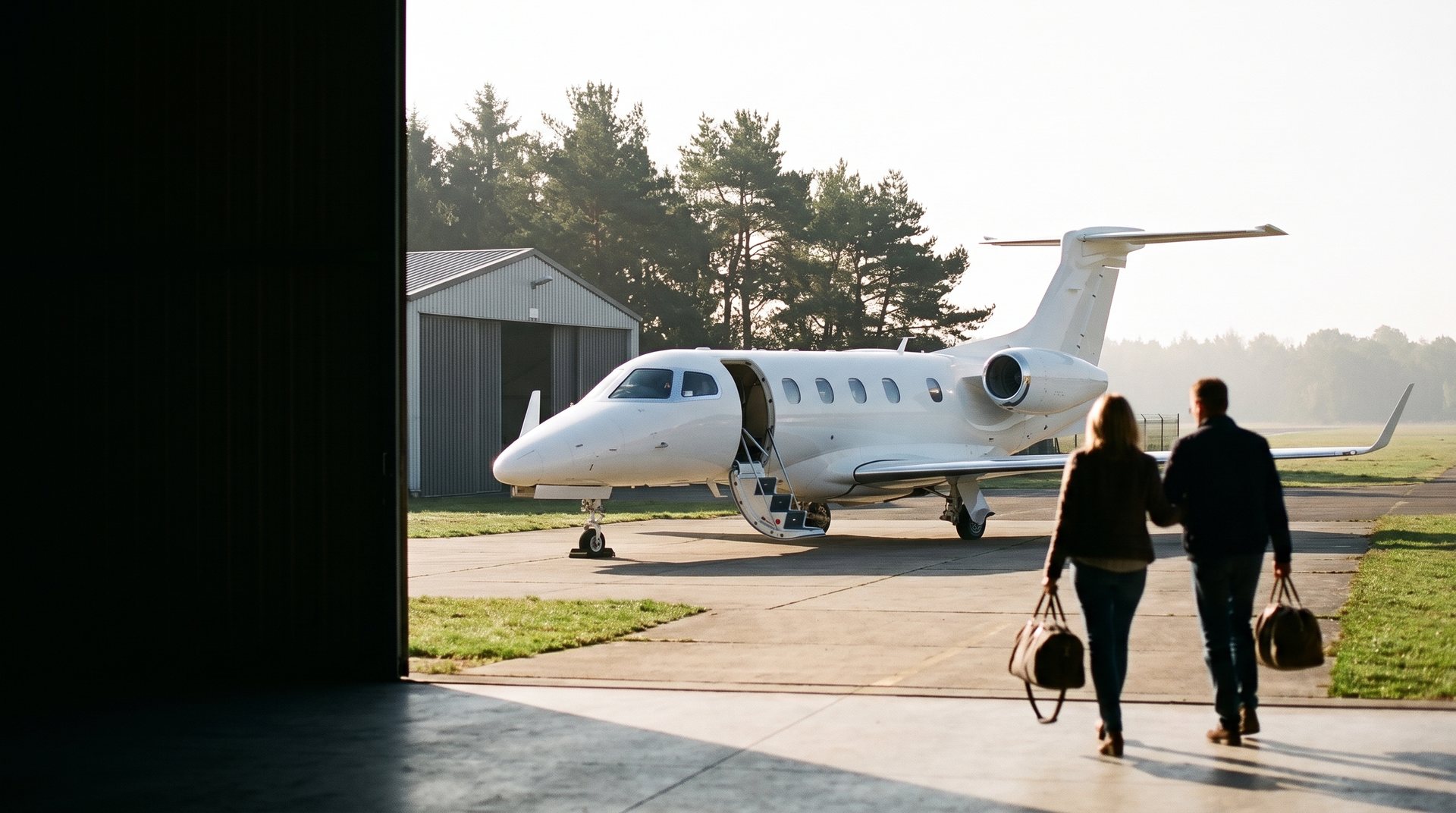
Light jets. Four to seven people, two or three hours.
The workhorse of European private flying. Enough range for London to the Mediterranean without stopping, small enough for airfields the bigger aircraft cannot use, and the least expensive way to have an aircraft to yourself.
PassengersTypically 5 to 7Several are certified for more, but the seats and the baggage hold run out at about the same point.
RangeRoughly 1,500 to 2,000 nautical milesAbout two to three and a half hours in the air, which covers London to almost anywhere in western Europe.
CabinSeated headroom, not standingMost light jets have a cabin you move around in crouched. A lavatory is usual, sometimes curtained rather than fully enclosed.
BaggageA case each for four to sixSkis, golf bags and pushchairs fit on some and not others. Tell us before the aircraft is chosen, not afterwards.
Category guidance. Figures are typical for the class rather than promises about a particular aircraft, and every quote names the actual aeroplane.
What it is for
The right aircraft for most European trips
Most private flights from London are under three hours with fewer than six people on board, and that is precisely what a light jet is built for. A meeting in Geneva and home the same evening, a family to Nice for the summer, four colleagues to Dublin and back. On those trips a bigger cabin is comfort you pay for and do not use.
The other advantage is where they can go. Light jets need less runway than the classes above, so they reach airfields closer to where you are actually going, and they are often the answer at airports that restrict aircraft by size, weight or approach certification. Aircraft are arranged with licensed commercial operators.
Widely available across European fleets, with a good baggage hold for its size
Cessna Citation CJ3+
6 to 7
About 2,000 nm
Quiet and efficient, happy on shorter runways
Cessna Citation CJ4
7 to 8
About 2,150 nm
A little more cabin and a little more range than the CJ3+
Bombardier Learjet 75
6 to 8
About 2,050 nm
Fast, with a narrower cabin than the Citations
Pilatus PC-24
6 to 8
About 2,000 nm
Flat floor and a large cargo door, and able to use short and unpaved runways
Published range figures assume still air and a light load. A full cabin, a hot day or a strong headwind all shorten what an aircraft will actually do on the day, which is why we check the specific trip rather than the brochure.
Range on the map
Where the class reaches
Drawn from Farnborough as true circles on the globe. The solid ring is the top of the class's typical range and the dashed ring is what most of its aircraft can plan on. Change the departure to see the reach from anywhere.
Published range85%, still-air planning
Light jets from Farnborough Airport (FAB). The solid ring is the top of the class's published range, 2,000 nautical miles; the dashed ring is 85% of the bottom of it, 1,275 nautical miles, which most aircraft in the class can plan on non-stop. Winds, payload and reserves reduce real range, so every trip is checked on the day.
A light jet is the right answer more often than people expect and the wrong one in a few predictable ways. These are the ones worth knowing before you choose.
You cannot stand up. On a ninety minute flight nobody minds; on three and a half hours with six adults, some do
Seats and bags compete. Six passengers with a case each is comfortable, six with skis is often not
On a long sector, a hot day or a short runway, fuel and payload compete, and the aircraft may be limited to fewer passengers than seats
There is no cabin crew, so catering is loaded cold and served by the pilots or by you
A small aircraft moves about more in turbulence than a large one on the same day
Choose a light jet
When it fits
The trips where nothing larger adds anything.
Two to six people, under about three hours in the air
Day trips within Europe where the aircraft waits
Airfields with shorter runways or size restrictions
Keeping the cost of the trip down without sharing the cabin
Type the two ends of the trip, and the number travelling if you know it. You will see the distance, a realistic time in the air, and which classes and aircraft can fly it without a stop, with this class marked.
Distances are great circle, the shortest line over the earth. Non-stop is judged against 85% of each aircraft's published still-air range, which leaves a sensible margin for reserves, wind and load. Times are a planning range for the time in the air, not a schedule. Aircraft are arranged with licensed commercial operators, and every quote is checked against the actual aircraft, the load and the forecast for your date.
Request a quote
Tell us the trip and the luggage
Route, dates, how many of you and what you are carrying. We will come back with the aircraft that actually suit, which is sometimes a light jet and sometimes not. Nothing is booked or charged online.
It depends on the route, the dates and where the aircraft happens to be, so a published hourly rate would mislead you. See what charter costs for how a quote is built, and send us the trip for a real figure.
Will our skis fit?
Sometimes. A few light jets take skis easily and others will not take them at all. Tell us the length and how many pairs at the enquiry stage and we will only offer aircraft that can carry them. See ski travel.
Can we reach the Canaries or Morocco?
Usually, but it depends on the aircraft, the load and the wind, and it is at the edge of the class. A midsize jet does the same trip with margin to spare.
Is a turboprop the same thing?
No. A turboprop is slower but lands on shorter and rougher strips, and can be a better answer for some mountain and island destinations. Ask us and we will compare both for your route.
Is it worth flying a light jet transatlantic?
No. The class cannot cross the Atlantic without stopping. For New York, look at heavy jets.