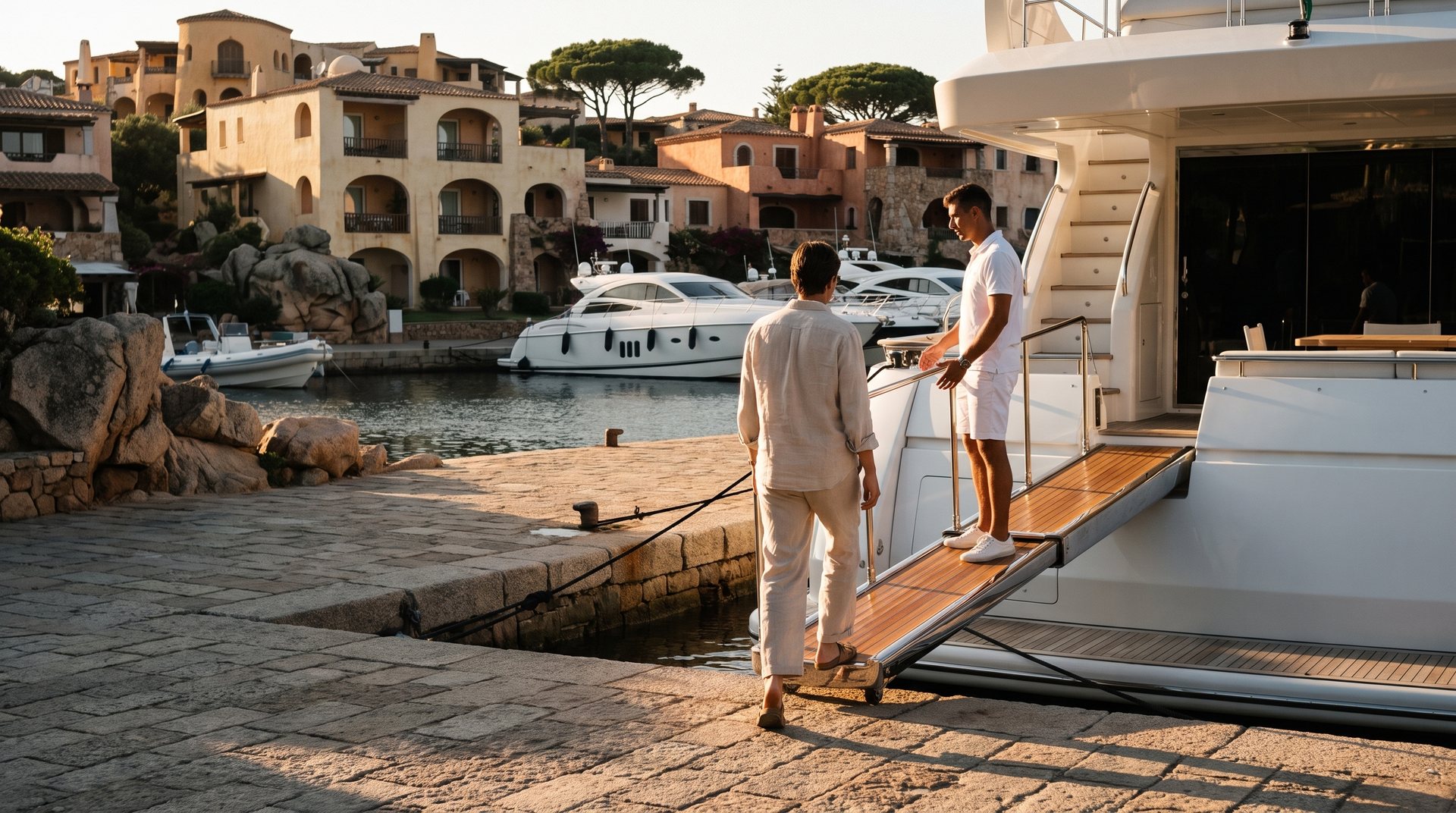
Your first superyacht charter. The things everybody assumes you already know.
Chartering a yacht is less like taking a villa than people expect and much less like a cruise. It has its own vocabulary, its own customs and one hard rule about numbers that shapes the whole decision. Here is all of it, before anybody asks you for a preference sheet.
What you are actually buying
A house, a crew and an address that moves
A crewed charter puts you aboard a private yacht with her own captain and crew for an agreed period, almost always a week, running from a port you choose to a port you agree. You are not sharing her with anybody, there is no fixed route, and the schedule is yours to change within what the sea, the weather and the port authorities allow. That combination of a private house, a professional crew and a moving address is the thing people fall in love with, and it is also why the arrangements are unlike anything else in travel.
The crew are the part that surprises first-timers most. On a yacht of any size there will be a captain, deck crew, engineers, interior crew and a chef, often one person for every guest or close to it. They live aboard, they have been doing this for years, and they are remarkably good at being present and invisible in the right proportions. Your job is not to manage them; it is to tell them clearly what you like, once, in writing, before you arrive.
Odyssey arranges yacht charters and the cars that meet you at either end. The yacht is run by her own captain and management, which is the correct arrangement and worth understanding from the outset: when we say we will confirm something, we mean we will get the answer from the people who own the decision.
The shape of it
How a week is usually put together
- GuestsTwelve, and no moreAn international rule rather than a preference. It is explained in full below and it is not negotiable.
- The periodA week, often Saturday to SaturdayShorter charters exist and cost proportionally more. Ten days and a fortnight are common in the Caribbean.
- The moneyA charter fee, plus an advance for what you consumeThe advance is the APA. Local tax and a gratuity sit alongside both.
- The agreementA standard industry charter contractIn the Mediterranean the MYBA form is the one most often used. Read it; it is short and it decides everything.
Regions differ. Some charters outside the Mediterranean include more in the fee and carry a smaller advance, or none at all. We tell you which applies to the yacht in front of you before anything is signed.
The rule that shapes everything
Twelve guests, and why it is absolute
Almost every charter yacht in the world sleeps a maximum of twelve guests, whatever her size. A hundred metre yacht with room for thirty will still take twelve. The reason is international maritime law: under the safety conventions, a vessel carrying more than twelve passengers is no longer a yacht but a passenger ship, and passenger ships are held to a wholly different standard of construction, fire protection, life-saving equipment, stability, crewing and survey. Building or converting a yacht to that standard is enormously expensive, so owners simply do not.
A small number of yachts are built or certified to carry more, under the passenger yacht rules, and they are rare, expensive and specified as such. If somebody offers you a charter for eighteen, ask on what basis before you get excited, because the usual explanation is that the extra six are day guests rather than people who will sleep aboard.
Day guests are the practical answer to a party larger than twelve, and they are perfectly normal: more people may come aboard while the yacht is alongside or at anchor within the rules that apply where she is, and go ashore again in the evening. Plan it in advance with the captain rather than announcing it on the day. If the whole party needs beds, the honest options are two yachts, a villa with a day charter alongside it, or a different kind of holiday.
The vocabulary
Words you will meet in the first week of looking
| The term | What it means | What it means for you |
|---|---|---|
| The charter fee | The cost of the yacht herself, her crew, her insurance and her own equipment for the period. | The headline figure in every listing. It is not the total, and comparing two yachts on it alone is misleading. |
| APA | The advance provisioning allowance: a float paid before the charter and spent by the captain on your behalf, at cost, with receipts. | Fuel, food, drink, berthing and port charges come out of it. Unspent money is returned. See the APA explained. |
| The preference sheet | A questionnaire covering food, drink, allergies, cabins, celebrations, activities and anything else you would like aboard. | The single most valuable document in the process. Vague answers become expensive guesses on the account. |
| Delivery and redelivery | Moving the yacht to where your charter starts, and away from where it ends, if that is not her own base. | Charged where it applies. Starting and ending where the yacht already is avoids it entirely. |
| The gratuity | A discretionary payment to the captain at the end, shared among the crew. It is a custom, not a charge. | Nobody will raise it with you, which is exactly why you should know about it before you go. |
| VAT and local tax | Charged on the charter fee according to where the charter begins and where she cruises. | Rules differ by country and change often. Confirmed in writing for your specific itinerary before you commit. |
| The base port | Where the yacht normally lies and where her crew, tenders and provisioning are set up. | Starting from her base is simpler, cheaper and usually better. It is the easiest saving in the whole process. |
The complete financial picture, with the ranges the market actually quotes, is set out on our charter cost guide. This page deliberately gives you the structure rather than figures.
The process
From first conversation to the last morning
- 01
The brief, which is mostly about people
Where, when, how many of you, what ages, what you actually enjoy, and the all-in figure you have in mind. Numbers and ages matter more than anything else, because cabin configuration decides which yachts are even possible for your party.
- 02
The shortlist and, if there is time, a visit
You will be sent a handful of yachts with full details. If the yacht is available to view in her base port, go: fifteen minutes aboard tells you more about a cabin, a shaded deck and a crew than forty pages of brochure.
- 03
The agreement, the payments and the preference sheet
The contract is signed, the fee is paid in instalments to the schedule it sets, and the APA goes with the balance. The preference sheet goes back to the crew in good time for them to provision properly, not the night before.
- 04
The week, and the settlement on the last morning
Ask to see the account midway through; it is entirely normal and the captain expects it. On the final morning the captain goes through the whole account with you, returns anything unspent and settles anything over. Ask for the summary in writing.
First-timer mistakes
The things people wish they had known
None of these are disasters. All of them are avoidable by asking one question earlier than you would have thought to.
- Choosing on length. A well laid out yacht of forty metres beats a badly laid out fifty for a family. Ask about the shaded deck space and where people will actually sit
- Ignoring the itinerary's effect on the budget. Long passages every day burn fuel and the fuel comes out of your advance. A captain will tell you honestly which legs are expensive
- Being polite on the preference sheet. Naming the wine you drink, the coffee you like and the thing you cannot eat is not fussy, it is the entire mechanism
- Forgetting the tender and the toys are included but their fuel is not, and that the yacht's own equipment is one of the better reasons to pick one yacht over another
- Assuming a marina berth every night. Anchoring off is quieter, cheaper and often better, and high season berths in famous ports are scarce as well as costly
- Booking the flights before the charter. The start port can shift during negotiation, and a changed aircraft slot is easier than a changed yacht
- Leaving the gratuity to the last hour. Decide before you sail what you intend to do, so that it is a considered thing rather than an awkward one
The itinerary
Built around the weather, not around a map
You will be asked what you would like to see, and a draft itinerary will come back. Treat it as a plan of intent rather than a timetable. The captain will change it during the week for wind, sea state and berth availability, and that is a feature rather than a failure: the whole advantage of a yacht is being able to move to where the weather is better on the morning it matters.
What is worth fixing in advance is the shape rather than the stops. How much of the week is passage and how much is at anchor. Whether you want a town most evenings or almost none. Whether there is a fixed commitment the yacht must be somewhere specific for: a dinner ashore, a birthday, a race weekend. And where the charter must end, because the redelivery point is a contractual matter rather than a preference.
The classic first charters are a week on the French Riviera between Saint-Tropez and the Italian border, the Balearics out of Palma or Ibiza, the Amalfi coast and the Aeolians, or the Caribbean in winter out of Antigua or St Barths. If your week includes an event, say so at the brief stage: Monaco Grand Prix week and the Monaco Yacht Show are berth problems rather than yacht problems, and they are solved in a different order.
Getting to her
The cars at both ends are part of the same arrangement
Embarkation and disembarkation days are the two most rushed days of a charter, and they are the two we can make uneventful. Aircraft, helicopter and cars timed to the yacht rather than to a schedule, on one itinerary and through one contact. Our own cars and employed chauffeurs are in London and Manchester; on the coast we arrange cars through operators we know.
Questions people ask
Before a first charter
How far ahead should we book?
For the Mediterranean high season, the winter before is normal and the good yachts go early. For the shoulder months, a few months is usually enough. For a famous event week, earlier than you think, and the berth is the constraint rather than the yacht.
Can we really only take twelve?
For sleeping aboard, yes, on almost every yacht, because of the international safety rules. Day guests are a separate and perfectly normal arrangement, agreed in advance with the captain.
Is a gratuity expected?
It is a custom rather than an obligation, given to the captain at the end to share among the crew where they have looked after you well. Our cost guide sets out the range the industry generally understands.
Motor or sail?
Motor for space, speed and stability, sail for the experience, the quiet and the lower running costs. Compare motor yachts and sailing yachts, and look at catamarans for families who want space without size.
What if somebody gets seasick?
Tell the captain at the brief stage. Itineraries can be built around short hops and sheltered water, and a larger or stabilised yacht behaves very differently in a swell. It is a routine conversation, not an awkward one.
Who actually runs the yacht?
Her captain and her management. Odyssey arranges the charter, and we are the contact who puts the week together and holds the whole itinerary, the cars at either end included.
Request a proposal
Tell us about the week you want
Where, when, how many of you and what ages, and the all-in figure you have in mind if you have one. We reply with yachts that genuinely fit and the full cost of each, the advance included, so you compare totals rather than headlines. Nothing is booked or charged online.
Prefer to talk? +44 2030 048300 or WhatsApp, at any hour.
One contact, wherever you are