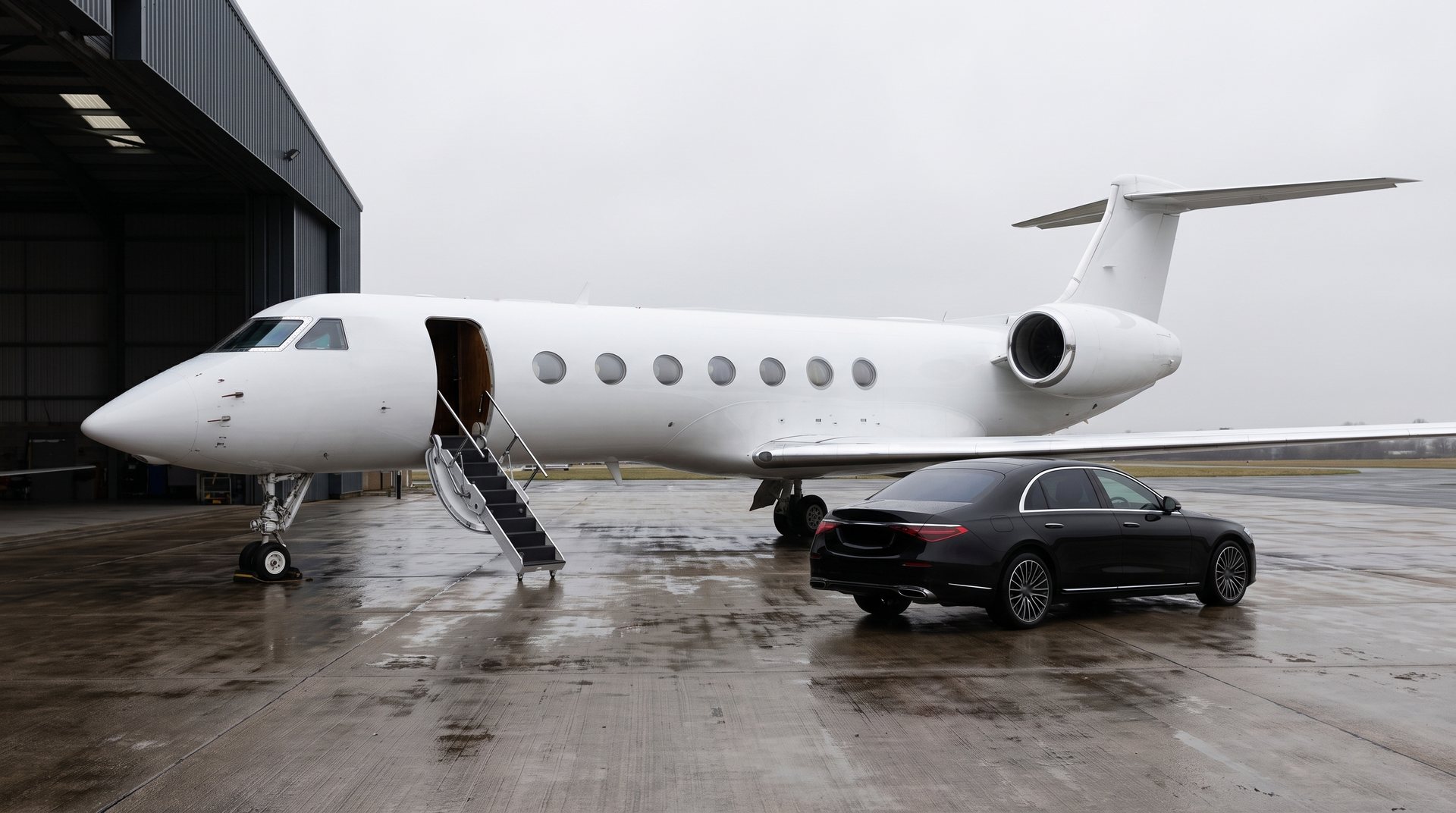
Heavy jets. London to New York, non-stop, either way.
The first category that crosses the Atlantic without thinking about it. Ten to sixteen people, a cabin divided into zones, cabin crew and somewhere to sleep that is not a reclined seat.
PassengersTypically 10 to 16Twelve in genuine comfort on a long sector, in two or three separate seating areas.
RangeRoughly 3,900 to 5,200 nautical milesAbout seven to ten hours in the air. London to New York, the eastern seaboard, the Gulf, west Africa and much of India.
CabinStanding, with separate zonesA forward club, a rear divan or second club, an enclosed lavatory and a full galley. Cabin crew are standard on charter.
BaggageA large hold, usually reachable in flightEnough for a dozen people travelling properly, with skis, golf bags or equipment cases as well.
Category guidance. Figures are typical for the class rather than promises about a particular aircraft, and every quote names the actual aeroplane.
What it is for
Long enough that the cabin is the point
On a two hour flight the aircraft is transport. On an eight hour flight it is where you are going to spend most of the day, and everything about a heavy jet is designed around that. Two or three zones mean some of the party can work at a table while others sleep, a real galley means hot food when people want it, and cabin crew mean somebody is looking after the cabin rather than the pilots leaving the flight deck to do it.
It is the usual answer for a board travelling to New York, a family relocating for a season, or a group where the flight itself is the working day. Aircraft are arranged with licensed commercial operators.
Examples
Aircraft you are likely to be offered
Aircraft
Typical seats
Typical range
Character
Bombardier Challenger 605 and 650
10 to 12
About 4,000 nm
An exceptionally wide cabin for the class, and very common on European fleets
Gulfstream G450
12 to 14
About 4,350 nm
London to New York non-stop in both directions in most conditions
Dassault Falcon 900LX
12 to 14
About 4,750 nm
Three engines and unusually good behaviour at shorter and restricted airports
Embraer Legacy 650
12 to 13
About 3,900 nm
A very large baggage hold and good value, with the shortest legs of this group
Bombardier Global 5000
12 to 13
About 5,200 nm
Approaching ultra-long-range capability, with a Global cabin
Published range figures assume still air and a light load. A full cabin and a winter headwind both reduce them, which is why we check the actual trip on the actual date rather than quoting the brochure. For the longer range aircraft one step up, see our guides to the Dassault Falcon 8X, the Bombardier Global 6000 and the Gulfstream G650.
Range on the map
Where the class reaches
Drawn from Farnborough as true circles on the globe. The solid ring is the top of the class's typical range and the dashed ring is what most of its aircraft can plan on. Change the departure to see the reach from anywhere.
Published range85%, still-air planning
Heavy jets from Farnborough Airport (FAB). The solid ring is the top of the class's published range, 5,200 nautical miles; the dashed ring is 85% of the bottom of it, 3,315 nautical miles, which most aircraft in the class can plan on non-stop. Winds, payload and reserves reduce real range, so every trip is checked on the day.
Reach from London
What the class does non-stop
Destination
Roughly
Realistic for the class?
New York
About 3,000 nm
Yes, both ways for the longer-legged aircraft. The shortest-legged may need a fuel stop westbound in winter
Dubai
About 2,950 nm
Yes, comfortably, for the whole class
Miami
About 3,850 nm
Yes for most, and marginal westbound in winter for the shortest-legged
Los Angeles
About 4,750 nm
Only the longest-legged, and usually with a stop westbound
Great circle distances, rounded, for planning only. What an aircraft will actually do on the day depends on the wind, the load and the runway at each end.
Said honestly
The trade-offs worth knowing
Heavy jets need more runway and more parking, so some of the small airfields a light jet uses are simply not available to them
The class spans a lot of ground. A Legacy 650 and a Global 5000 are both heavy jets and differ by well over a thousand miles of range
Westbound across the Atlantic in winter is the honest weak point of the shorter-legged aircraft. A planned technical stop adds about an hour and is far better than a diversion
Positioning matters more at this size. There are fewer heavy jets about, so if none is near you, the empty flying in the quote will be noticeable
Filling sixteen seats is usually a mistake on a long sector. Twelve people in a cabin built for sixteen is what the class is actually good at
For more than sixteen passengers the answer is not a bigger business jet but an airliner. See group charter
Type the two ends of the trip, and the number travelling if you know it. You will see the distance, a realistic time in the air, and which classes and aircraft can fly it without a stop, with this class marked.
Distances are great circle, the shortest line over the earth. Non-stop is judged against 85% of each aircraft's published still-air range, which leaves a sensible margin for reserves, wind and load. Times are a planning range for the time in the air, not a schedule. Aircraft are arranged with licensed commercial operators, and every quote is checked against the actual aircraft, the load and the forecast for your date.
Request a quote
Tell us the trip and the date
For a long sector the date matters as much as the route, because the wind decides whether it is non-stop. Send us both, with the number of passengers, and we will tell you plainly. Nothing is booked or charged online.
In both directions, yes, on the longer-legged aircraft in the class. On the shortest-legged, a westbound winter crossing may need a technical stop of about an hour. We tell you which it is when we quote, not afterwards.
Is there somewhere to lie down?
On most heavy jets a divan converts to a bed, and the seats in the club recline flat or nearly so. Proper separate beds start in the ultra-long-range class.
Can it land at Biggin Hill or Farnborough?
Many heavy jets can, subject to the aircraft, the load and the conditions. It is checked for your specific trip rather than assumed, and the answer sometimes changes with the amount of fuel on board.
We are eighteen people. What then?
That is beyond the business jet ladder. An airliner is chartered instead, and the cabin can be configured for the group. See group charter.
What does it cost?
It depends on the route, the dates and where a suitable aircraft is, and positioning matters more at this size than any other. See what charter costs.