Flying privately with children. The aircraft is the easy part.
Families charter for one reason above all others: no queue, no gate, no three hours of managing a toddler in a terminal. That part works. What catches people out is smaller and duller, and always the same four things: the car seat, the cabin, the timing of the day, and a document that somebody asks for at a border.
What changes
Nothing about the flight, and everything about the day around it
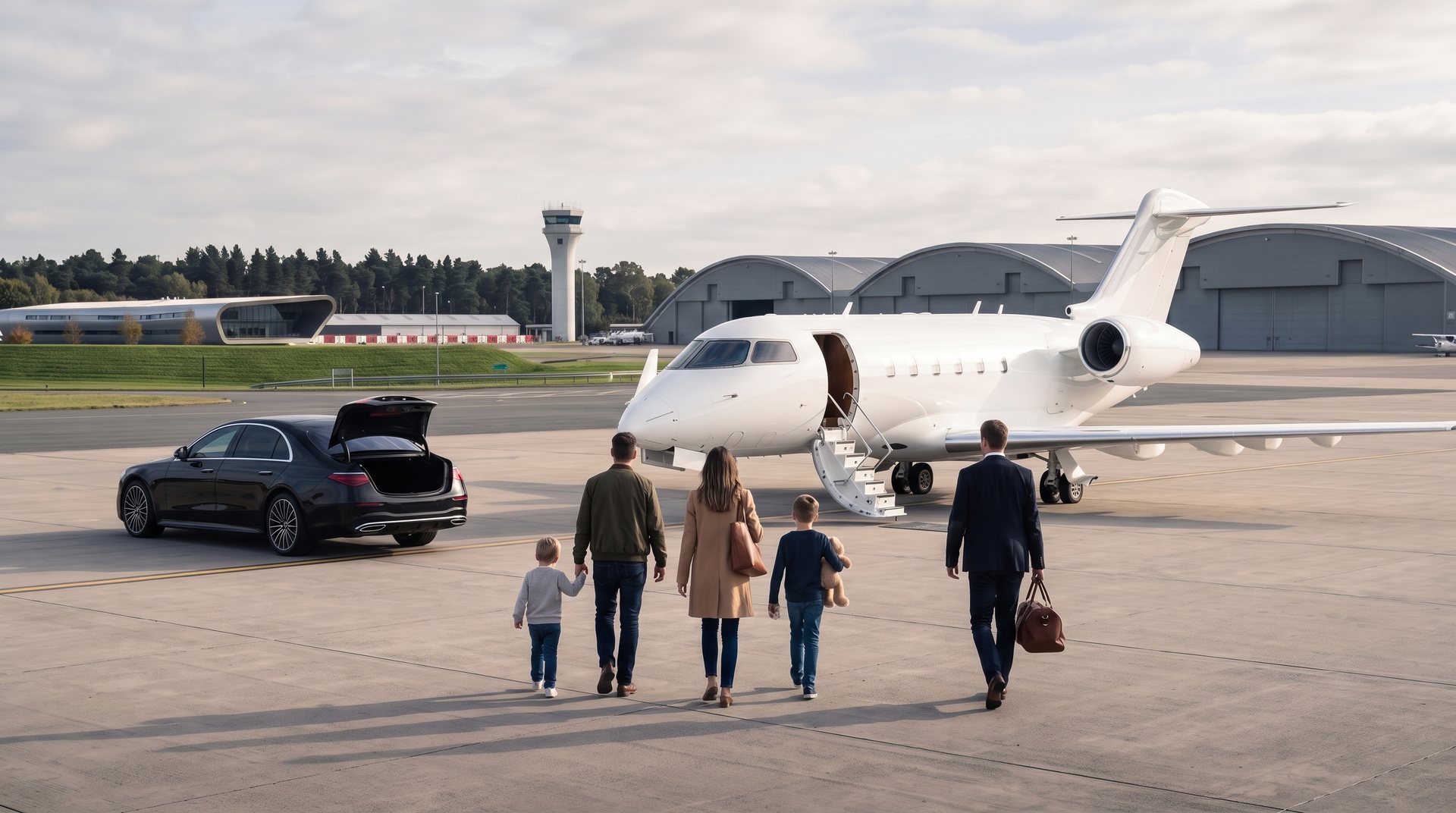
A private trip with children is not a different flight. It is the same aircraft with a different day wrapped around it. Instead of arriving two or three hours early you arrive twenty minutes early, and instead of a gate you have a lounge you can walk straight through. That is the whole point, and for a family with a baby, a toddler and a six-year-old it is worth more than anything else you can buy.
The friction moves somewhere else, though, and it moves to the joins. The car at the front door, where the question is which seats are in it. The aircraft cabin, where the question is what a seat is actually certified to take and whether there is anywhere civilised to change a baby. The timing, because a schedule built around a principal's diary and a schedule built around a two-year-old are not the same schedule. And the documents, because a child travelling with one parent is the single most common reason a family is delayed at a border.
None of it is difficult. All of it wants to be settled at the enquiry, not on the morning. What follows is what we ask families, and why.
In the car
Child seats, and what the law actually says
| The passenger | The rule in Great Britain | What it means for the journey |
|---|---|---|
| Any child under 12 years old or under 135 cm tall, whichever comes first | Must use the correct child car seat or booster in a car, van or goods vehicle. After 12 or 135 cm, an adult seat belt | This is the standard to plan to, whoever is driving. Tell us each child's age and height at the enquiry and we will tell you what we can put in the car |
| A child aged 3 or over in a licensed taxi or private hire vehicle | Where a suitable child seat is not available, may travel in the rear on an adult seat belt | An exemption exists, and a licensed chauffeur car falls under it. We would rather not rely on it, and neither would most parents. It is a fallback, not a plan |
| A child under 3 in a licensed taxi or private hire vehicle | Where a suitable child seat is not available, may travel in the rear without one | Legal, and not what anybody wants for a baby. If a seat matters to you, say so at the enquiry rather than at the kerb |
| Any child not in the correct restraint | Must travel in the rear. Front seat travel without the correct restraint is not permitted | Children ride in the back, which is where the room and the bags are anyway |
This is the position in Great Britain, summarised from the published rules and correct at the time of writing. Other countries set their own rules and they differ, sometimes sharply, so outside the UK we confirm the local position with the operator before the day. Ask us what we can carry for your journey rather than assuming: seats are a question of what is in that vehicle on that morning.
In the cabin
Which aircraft, and the questions worth asking first
Business jets are certified individually, so the honest answer to almost every cabin question is that it depends on the aircraft and the operator, and that it is worth asking before anything is agreed rather than afterwards. The questions that matter to a family are short. Can an infant travel on an adult's lap with a supplementary belt, and does this operator do that? Will this aircraft accept your own car-type child restraint, and in which seat? Not every seat on a business jet faces forward, and a seat in a club four faces the wrong way for a car seat. Is there anywhere to change a baby other than the lavatory floor? Does the cabin have a divan or a berthable seat, which is the difference between a sleeping child and a long night for everybody?
On size, the useful rule is that families outgrow aircraft faster than they expect. A light jet is a perfectly civilised two hour aeroplane for two adults and a child, and it has a small lavatory and very little baggage volume. A midsize or super-midsize cabin is where a family of four or five starts to breathe, with a proper lavatory and room for a pushchair. Heavy jets and ultra-long-range aircraft have the berths, the galley and the separate spaces that make an overnight sector work with small children. The choice is usually about the hours in the air and the number of bags rather than about luxury. See choosing the right jet category.
Two practical points that people only learn the second time. Pushchairs and travel cots are bulky rather than heavy, and baggage compartments on smaller jets are shaped awkwardly, so give the count and the folded sizes rather than a rough figure. And the climb and descent are the parts small children notice, so for a short sector it is worth telling the operator that you would rather have a longer, gentler descent than the quickest one. That is an operational request, freely made, and crews are used to it.
Before you book
What to tell us, and what we will ask the operator
Everything here is quicker to settle at the enquiry than on the day, and every one of these has caught a family out at least once.
- Each child's age and, for the car, rough height. Ages decide the aircraft questions and heights decide the seats
- Whether you are bringing your own child restraint. If so, tell us the make and whether it is the type that belongs in a car, because the operator will need to know before it reaches the aircraft
- Pushchairs, travel cots and car seats, counted and described folded. They decide the baggage compartment more often than the suitcases do
- Nap and bedtime, honestly. A departure moved by ninety minutes is usually possible and almost always cheaper in temper than the alternative
- Whether a nanny or a second adult is travelling, and whether they are on the same passport document trail as the children
- Anything about the walk. Private terminals are small, but the apron walk to the aircraft is outdoors and the steps are steps. If somebody is carrying a baby and a bag, we will bring the car as close as that terminal permits. See private jet and FBO transfers
- Whether a pet is coming too, which has its own rules and its own paperwork. See travelling with pets
The day
How a family departure actually runs
- 01
The car
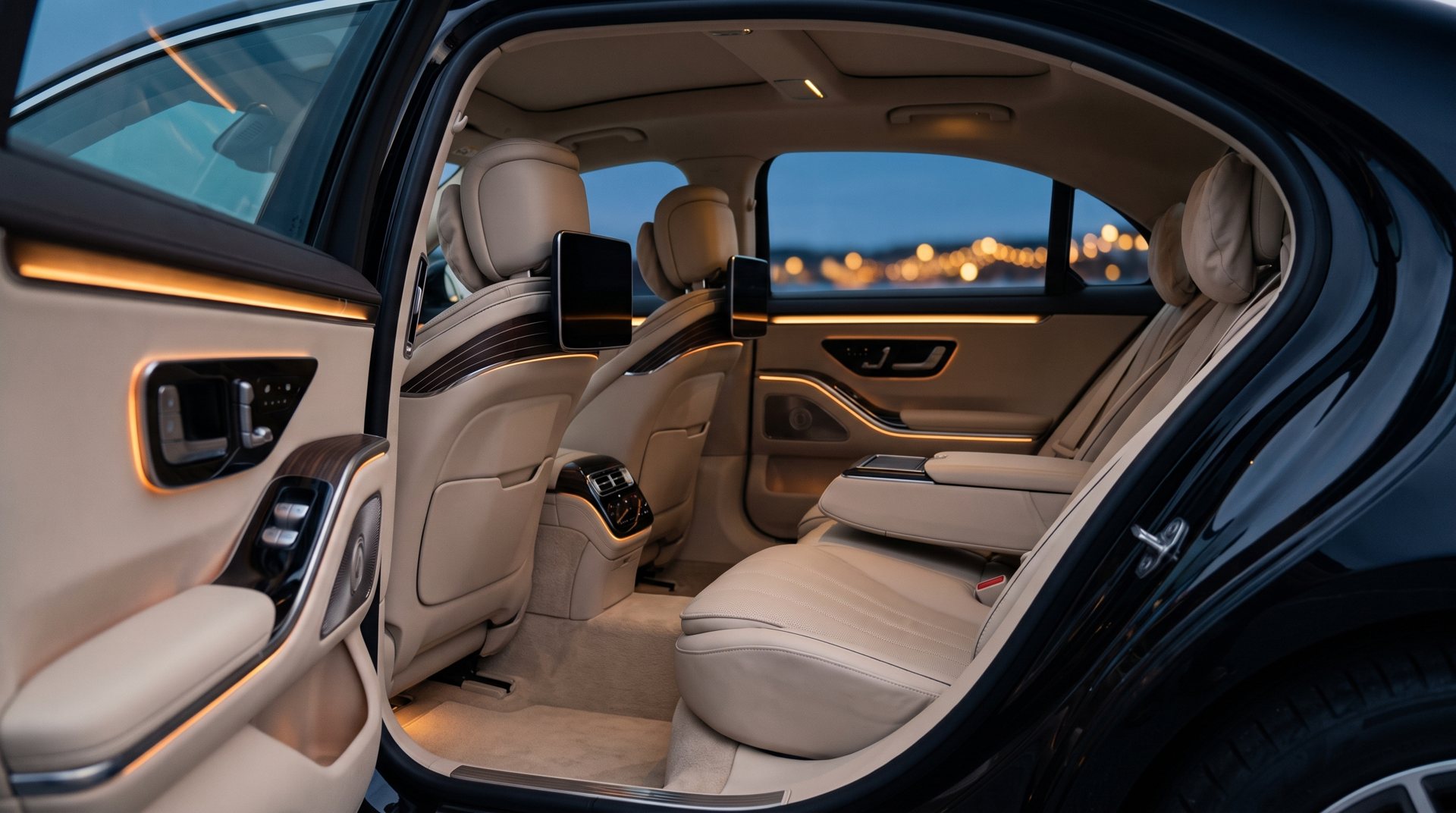
The chauffeur arrives early and waits rather than ringing the bell at the agreed minute, because a family leaves the house when it leaves the house. Seats are fitted before the car leaves base, not at your kerb.
- 02
The terminal
A private terminal is a room, not a concourse. Arrival is usually twenty to thirty minutes before departure rather than hours, security and documents are done in that room, and nobody is separated from a pushchair. See London's private terminals compared.
- 03
The aircraft
Bags go from the car to the hold in one movement. If the terminal permits ramp-side collection for your flight, the walk is a few metres; if it does not, it is a short bus or a short walk, and we tell you which beforehand rather than after.
- 04
The other end
The same in reverse, with the car meeting the aircraft where that airport allows it. We track the flight, so a two hour delay on a school holiday Friday is our problem rather than a series of telephone calls from you.
Documents
Passports, and the letter one parent should be carrying
Children need their own passports, and children's passports are valid for fewer years than adults' are, which is why the expiry date on a six-year-old's passport is the one most often missed in a family of five. Check all of them together, well before the trip, and check the entry requirements of the destination too: plenty of countries want a period of validity remaining beyond the date you leave.
The second document is the one that causes the delays. Where a child is travelling with only one parent, or with a grandparent, a nanny or a guardian, border officials and airline staff may ask for evidence that the adult is entitled to travel with them. There is no UK law that requires a letter of consent to take your own child abroad, but a number of countries do ask for one, and carrying it costs nothing. A useful letter names the child and their date of birth and passport, names both parents or guardians with contact details and passport details, sets out the destination and the dates, and is signed by the parent who is not travelling. It is sensible to carry the child's birth certificate alongside it, and where surnames differ, whatever document explains that: a marriage certificate, a change of name deed, or the relevant court order.
Two honest caveats. Some countries want that letter notarised, and some want more besides, so the requirement belongs to the country you are entering rather than to the aircraft. And this is general guidance from published sources, not legal advice: for anything to do with parental responsibility, custody arrangements or a court order, the people to ask are your solicitor and the destination's own authorities. What we will do is make sure nobody discovers the question at the terminal door.
Children travelling alone
Teenagers, schools and guardians are a different arrangement again
Exeats, the end of term and the flight home have their own rules, their own named adults at both ends, and their own paperwork. We handle them as a separate service with confirmations in writing to whoever is responsible for the child.
Questions parents ask
About flying with children
Will the car have a child seat?
Ask us for your journey and we will tell you straight. Seats are a question of what that vehicle is carrying on that morning, and we would rather say yes to a specific booking than publish a promise we cannot keep every time. Give us ages and heights at the enquiry and it is settled before anybody leaves the house.
Can we bring our own car seat on the aircraft?
Often, and it depends on the aircraft, the seat and the operator. Not every business jet seat is suitable and not every restraint is accepted, so tell us at the enquiry what you have and we will have the operator confirm it in writing rather than at the steps.
How early do we need to arrive?
Usually twenty to thirty minutes before departure at a private terminal, and we build the car timing backwards from that rather than from a generic figure. For a family we normally add a margin at the house end instead, because that is where the time actually goes.
How many bags can we take with a family of five?
It is the shape rather than the weight that decides it: pushchairs, travel cots and car seats fill a small jet's baggage compartment quickly. Give us the count and the folded sizes and the operator will tell us the aircraft that works, which is often one category larger than the passenger count suggests.
Do you charge for waiting when a departure slips?
We will not quote terms on a web page. Tell us the journey and we will set out clearly what is included and what is not, in writing, before you commit to anything.
Can the same plan cover the ski trip and the summer?
Yes, and for most families that is the easier way to run it: one contact, one set of preferences recorded once. See the ski season guide and family offices, or open an account.
Request a quote
Tell us the ages
Route, dates, how many adults and children, the ages, and what is coming with you in the way of pushchairs, cots and seats. We come back with aircraft options that genuinely fit the family, what the operator will and will not accept in the cabin, and the car arrangements at both ends. Nothing is booked or charged online.
Prefer to talk? +44 2030 048300 or WhatsApp, at any hour.