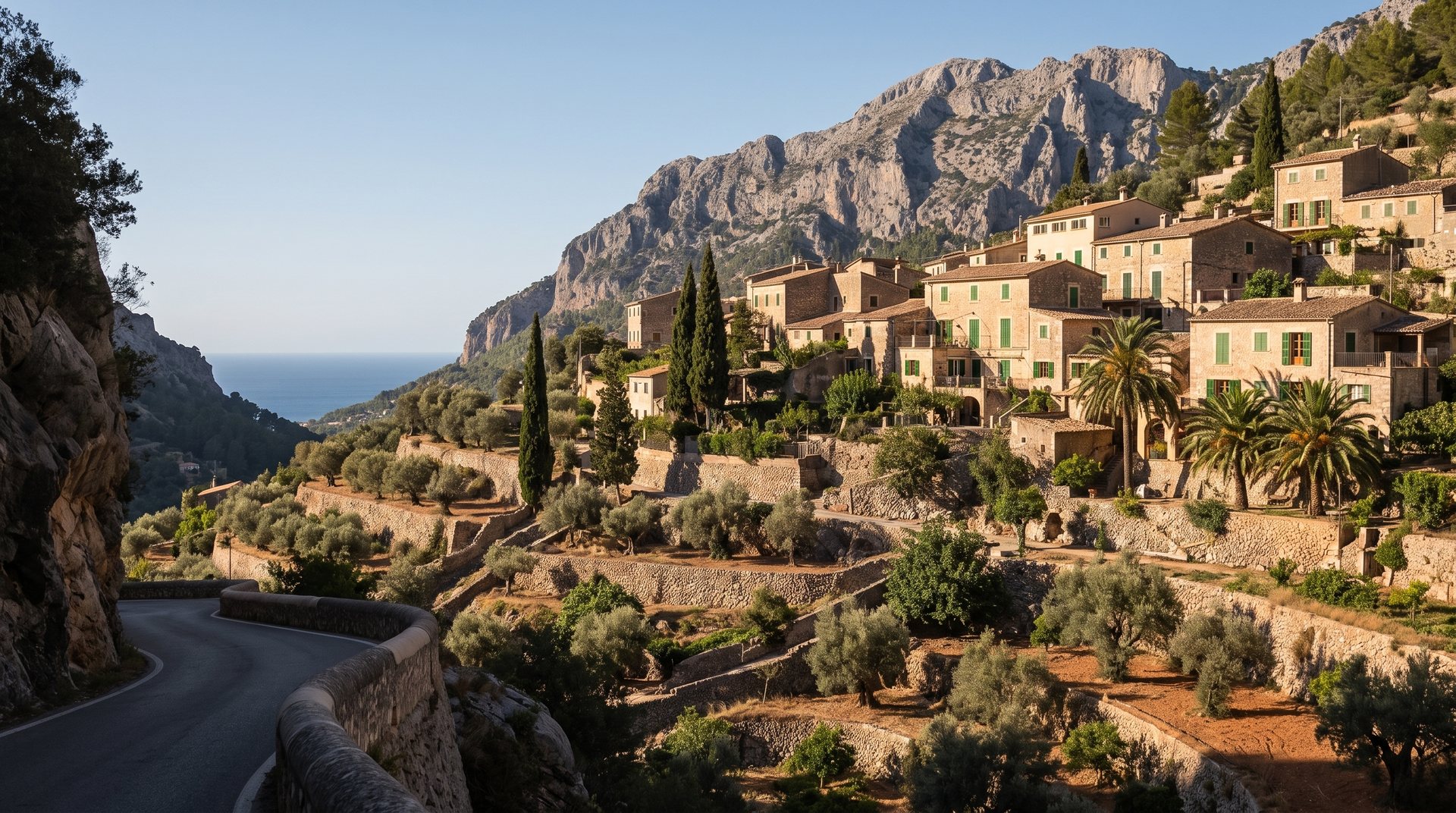
Mallorca. One airport, one city, and four very different islands around them.
Palma is the easy part. What decides your day is which coast you are going to, because the drive to the north of the island takes twice as long as the drive to the south west.
The essentials
Mallorca at a glance
- AirportPalma de Mallorca (PMI)Open around the clock for private aviation, with the general aviation terminal on the eastern side of the field.
- The yachting capitalPalma bayClub de Mar, Puerto Portals and Port Adriano between them take everything up to the largest yachts afloat.
- SeasonApril to OctoberJuly and August are the peak. Spring and late September are warm, open and much easier to arrange.
- Where people staySouth west, Palma, Tramuntana, northAndratx and Portals in half an hour, Deia in about fifty minutes, Pollensa in an hour.
Arriving
A large airport with a small private corner
Palma is one of the busiest airports in Spain and in high summer the scheduled traffic is relentless, which is the context every private movement here sits inside. The general aviation terminal is on the eastern side of the field and operates around the clock, which is a real advantage over the smaller Mediterranean airfields: a late arrival or an early departure is possible here in a way it is not at Cannes Mandelieu or on the Costa Smeralda.
Slots and parking are still restricted through July and August, so the aircraft's ability to stay on the ground between your outbound and your return is a question for your operator rather than an assumption. Ask it early. If the answer is that the aircraft must reposition, that is normal for the Balearics in August and simply needs to be in the plan. See Palma airport and London to Palma.
On the ground
Road transfer ranges from Palma airport
| To | Quiet roads | July and August |
|---|---|---|
| Palma centre and Club de Mar | 15 to 25 minutes | 25 to 40 minutes |
| Puerto Portals | 20 to 30 minutes | 30 to 45 minutes |
| Port Adriano | 25 to 35 minutes | 35 to 50 minutes |
| Port d'Andratx | 35 to 45 minutes | 45 to 70 minutes |
| Deia and Valldemossa | 45 to 60 minutes | 1 hour to 1 hour 20 |
| Port de Pollensa and Formentor | 55 to 70 minutes | 1 hour 15 to 1 hour 40 |
Realistic ranges, not promises. The motorway network around Palma is good; the Tramuntana coast road to Deia is winding, single carriageway and slow by design, and in spring it carries a great many cyclists.
On the water
Which marina takes which yacht
Palma bay is the centre of Mediterranean yachting west of Italy, and the choice of marina is usually made by length. Club de Mar, immediately west of the commercial port, has several hundred berths and can take vessels up to around 170 metres. Port Adriano, further west past Portals, is built around larger yachts, with a run of berths in the twenty to eighty metre range. Puerto Portals sits between the two in size and in character, taking boats to around sixty metres with the restaurants and shops on the quay.
Beyond Palma bay, Port d'Andratx is smaller and prettier and fills early, and the north coast around Pollensa and Alcudia is a different proposition again, with shallower water and fewer large berths. Anchoring anywhere in the Balearics is governed by the rules protecting the posidonia seagrass meadows, so the captain works to the official seabed charts. See Palma superyacht marinas and yacht charter.
Planning it well
What regular visitors do
- Decide the coast before the villa. Fifty minutes to Deia each way is a different holiday from twenty five minutes to Portals
- For the Tramuntana, ask for a driver who does that road regularly. It is narrow, it is busy with cyclists in spring, and it punishes guesswork
- Give the return date with the outbound in July and August, so slots and parking can be coordinated together
- If you are joining a yacht, give us the marina and the berth. Access to the pontoons is controlled and the car needs to be in the right place
- Spring and the second half of September have the same sea and roughly half the pressure on everything that must be booked
- For August, and for the weeks either side of Palma's spring boat show and the early August regatta, plan months ahead
Three services, one trip
How people use us here
Start planning
Tell us which coast
Dates, how many of you, and the villa, hotel or marina. If you are looking at a yacht, tell us the length you have in mind and we will tell you honestly which berths are realistic for your week. Nothing is booked or charged online.
Prefer to talk? +44 2030 048300 or WhatsApp, at any hour.
Questions people ask
About Mallorca
Can our aircraft arrive late in the evening?
Palma handles private aviation around the clock, which is unusual in the Mediterranean and makes it a far more flexible island to arrive at than most.
Can the aircraft wait for us?
Sometimes. Slots and parking are restricted in July and August, so it is a question for your operator, asked when you book rather than the week before.
How long is the drive to Deia?
Between forty five minutes and an hour and a quarter depending on the season and the hour. The road is beautiful and there is no quick version of it.
Are these your own cars?
No. Our own fleet and our own chauffeurs are in London and Manchester. In Mallorca cars are arranged through operators we know, and one person at Odyssey holds the itinerary together.
Can you arrange Ibiza in the same trip?
Yes, by air or by sea. It is a short hop either way, and the two islands are often combined. See Ibiza.