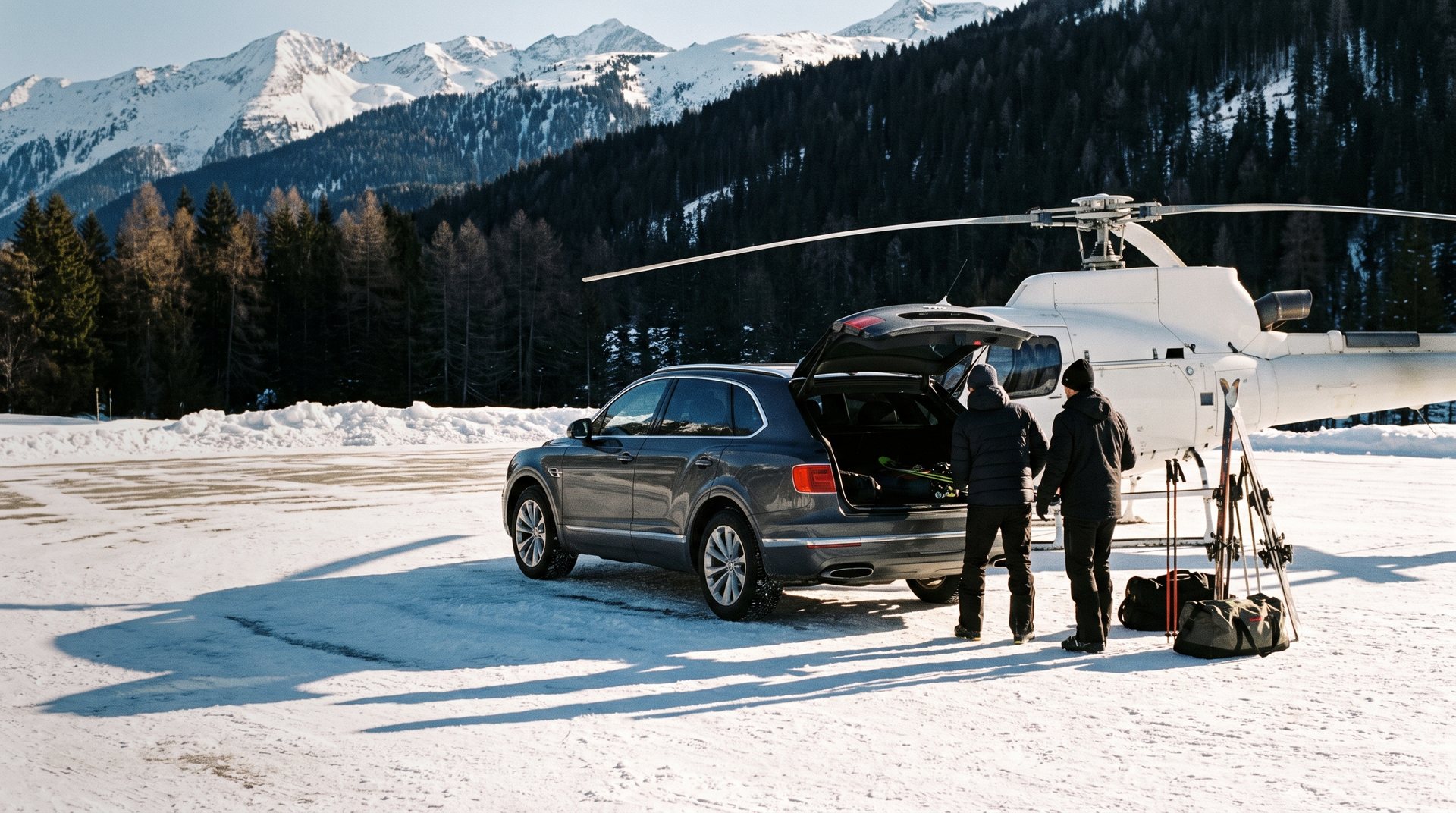
The ski season. Door to chalet on one plan, with the fallback airfield agreed before you fly.
Alpine travel goes wrong in predictable ways: the wrong airfield, the wrong day of the week, a crew who are not qualified for the approach, and four more bags than anybody counted. Plan it with us in October and none of that reaches you in February.
The shape of the trip
Three legs, and only one of them is flying
A private ski trip has three parts. The car from your door to a London private terminal, driven by one of our own chauffeurs. The aircraft to a valley airport. And the last fifty miles, which go up a mountain by road or by helicopter. Almost every problem people describe afterwards happened at a join between two of those three, and almost every one was foreseeable.
The most useful decision is made before anything is booked: which airfield, and which airfield behind it. The Alps have three airports that put you genuinely close to a resort, and every one has conditions attached. Geneva, Zurich and Lyon have none of those conditions and cost you an hour or two of road instead. A trip planned as one airfield with a named alternative survives a bad forecast. A trip planned as one airfield does not. Everything below assumes the aircraft is arranged for you and the mountain cars are arranged through operators who drive those valleys every day: our own cars and chauffeurs are in London and Manchester, and one contact at Odyssey holds the whole thing together.
The airfields
The three mountain airports, and what each demands
| Airfield | What it buys you | What it asks of you | The alternative behind it |
|---|---|---|---|
| Chambéry Savoie Mont Blanc (CMF) | The Three Valleys within reach: about 1 hour 15 to 1 hour 45 to Courchevel in good conditions, against two and a half to three hours from Geneva | Prior permission for every flight, about five arrivals an hour at weekends in the season, an instrument approach in one direction only, and crews specifically trained for the terrain, with training required below roughly a 3,500 foot ceiling or 5,000 metres of visibility and after dark. Friday to Sunday parking is limited and there is no hangarage | Geneva, about 2 hours 30 to 3 hours to Courchevel, or Lyon on the motorway |
| Sion (SIR) | The shortest transfer in the Alps for Verbier: about 40 to 55 minutes by road, or about 10 minutes in the air to the Le Châble heliport. Täsch, for Zermatt, is about an hour to an hour and a quarter | A specific airport authorisation held at one of two levels, which decides the minima and whether an evening arrival is possible at all. From October to March the field closes at sunset. Military airspace above the valley is active on weekdays, and the Foehn makes the approach turbulent | Geneva, about 2 hours to 2 hours 30 to Verbier |
| Samedan Engadin (SMV) | St Moritz in about ten minutes. Nothing else in the Alps comes close | Elevation of about 1,707 metres, which flattens climb performance and can mean fewer passengers or less fuel. No runway or approach lighting, so winter operations end with evening civil twilight. Every pilot must hold the airport's familiarisation briefing, current within two years | Zurich, about 2 hours 30 to 3 hours over the Julier Pass |
| Courchevel Altiport (CVF) | Five to fifteen minutes to any of the four Courchevel villages | A 537 metre runway at 2,008 metres on a gradient of about 18.6 per cent, with no go-around. Small aircraft and helicopters only, flown by crews holding the French mountain qualification or a site authorisation, in daylight and good visibility. Business jets cannot use it | The road from Chambéry or Geneva, or a helicopter from either |
Airfield facts as verified on our own airport pages and reviewed each season. Road times are realistic ranges in normal winter conditions, not promises. Every one of these fields can be closed by weather at short notice, which is why the last column exists.
Peak weeks
Three weeks decide the whole season
The Alpine calendar is not evenly loaded. New Year, the February half-term weeks and Easter account for the overwhelming majority of the pressure, and they compete for a small fixed supply: weekend arrival slots at Chambéry, parking for the aircraft, helicopter capacity, and drivers who know the valley roads in snow. For those weeks the honest advice is to have the conversation in the autumn: not to book everything, but to say which week you want and how many of you there are, so the aircraft and the ground arrangements can be held together rather than assembled from what is left.
Within a peak week, the day of arrival matters more than most people expect. Saturday is changeover day: the flights, the airports and the valley roads are all at their worst at once, and a transfer from Chambéry to Courchevel that takes an hour and a quarter on a Tuesday can take three and a half hours on a Saturday in February. A Friday or a Sunday movement is easier on everyone, and it is often the cheapest change you can make to a trip.
Weather
Diversions are normal. Surprises are not
Mountain airfields are closed by weather every winter, and the professional response is not to avoid them but to plan the alternative at the same time as the first choice. We agree the fallback before departure, every time. If the crew change their mind in the air, the driver is already moving towards the other airport and the chalet has been told what time you will now arrive.
The three ways this goes wrong are worth naming. The first is planning a mountain airfield without an alternative, so a marginal forecast becomes a scramble. The second is assuming a crew is qualified for the field, when Chambéry requires specific training, Sion requires an authorisation and Samedan requires a briefing that expires after two years. Ask your operator directly, and early. The third is the return: an airfield that was open when you arrived can be closed when you leave, and in midwinter at Samedan the last comfortable departure is lunch rather than dinner.
The last leg
Helicopters: quick, and conditional
A helicopter turns the last leg from a drive into a hop. From Chambéry to Courchevel it is in the order of fifteen to twenty minutes and from Geneva around thirty to thirty five, into the altiport above Courchevel 1850. From Sion to the Le Châble heliport, at the foot of the Verbier road, it is about ten minutes in the air.
Two conditions apply to all of it. It needs daylight and acceptable visibility, which in late December means the working day is short and a night arrival is a road transfer whatever you booked. And capacity for the peak weeks goes early. We hold a road plan behind every helicopter leg as a matter of course, and we would rather say so in October than at ten o'clock on the apron.
Luggage
Count the skis before you choose the aircraft
Ski luggage decides the aircraft type and the number of vehicles more often than the passenger count does, and it is the thing most often given as a rough figure.
- Count sets of skis or boards and boot bags separately from suitcases. Six people with six sets of skis is a different aircraft from six people with hand luggage
- Tell us the length of the skis. Some light jets take them in the cabin, some in an external compartment and some not at all
- Say if anybody is hiring at the resort. It is often the sensible answer for children, whose skis change size every year anyway
- For the mountain cars, count boot space rather than seats. A seven-seat vehicle full of people has very little room left for a week's bags and a set of skis each
- Where a chalet cannot be reached by a large vehicle in snow, the bags are carried the last part. Send the address and a pin in advance and we will say honestly where the car can stop
The timeline
When to do what
- 01
October and November
The week and the numbers. For the peak weeks this is when aircraft and ground arrangements are held together. Nothing needs to be final, but the request needs to exist.
- 02
Four to six weeks out
The detail. Chalet address, ski and bag count, arrival and departure times, and the decision on a helicopter leg.
- 03
The week before
The plan on paper. Airfield, alternative airfield, transfer times for that day of the week, and what happens if the crew divert.
- 04
The day
One number. Weather moves, slots move, the descent is slower than the climb. The desk watches the flight and moves the cars rather than asking you to.
Resort by resort
Every resort has its own page, with its own road
The destination pages set out the local realities: Courchevel's four villages on one access road above Moûtiers, the nine kilometres of hairpins from Le Châble up to Verbier, and the passes into the Engadin for St Moritz.
Questions people ask
About the ski season
Can a jet land at the resort itself?
No. The valley airports take jets and the resort airfields do not. Courchevel's altiport is limited to small aircraft and helicopters with specially qualified crews, in daylight and good visibility. The last leg is by road or by helicopter.
Chambéry or Geneva for Courchevel? Sion or Geneva for Verbier?
The mountain field for the shortest journey, Geneva for certainty. We usually plan the first and hold Geneva behind it, and we agree with you beforehand which way we will jump.
Why might our operator refuse a mountain airfield?
Usually because the crew are not trained, authorised or current for that specific field, or because the forecast is below the minima, or because performance at altitude will not carry your passengers and fuel. All three are reasonable answers and none is the operator being difficult.
When should we book?
For New Year, February half-term and Easter, in the autumn. For other weeks a few weeks ahead is usually enough. Helicopter capacity goes before aircraft capacity.
Are the cars in the Alps yours?
Our own cars and chauffeurs are in London and Manchester, and a trusted global network covers everywhere else. Alpine transfers come through operators we know, with winter tyres and chains, and one contact at Odyssey holds the itinerary from the front door to the chalet.
Request a quote
Tell us the week
Resort, chalet, dates, how many of you and how many sets of skis. We reply with aircraft options, the airport we would use and why, the fallback airfield, and an honest transfer time for that day of the week. Nothing is booked or charged online.
Prefer to talk? +44 2030 048300 or WhatsApp, at any hour.

One contact, wherever you are