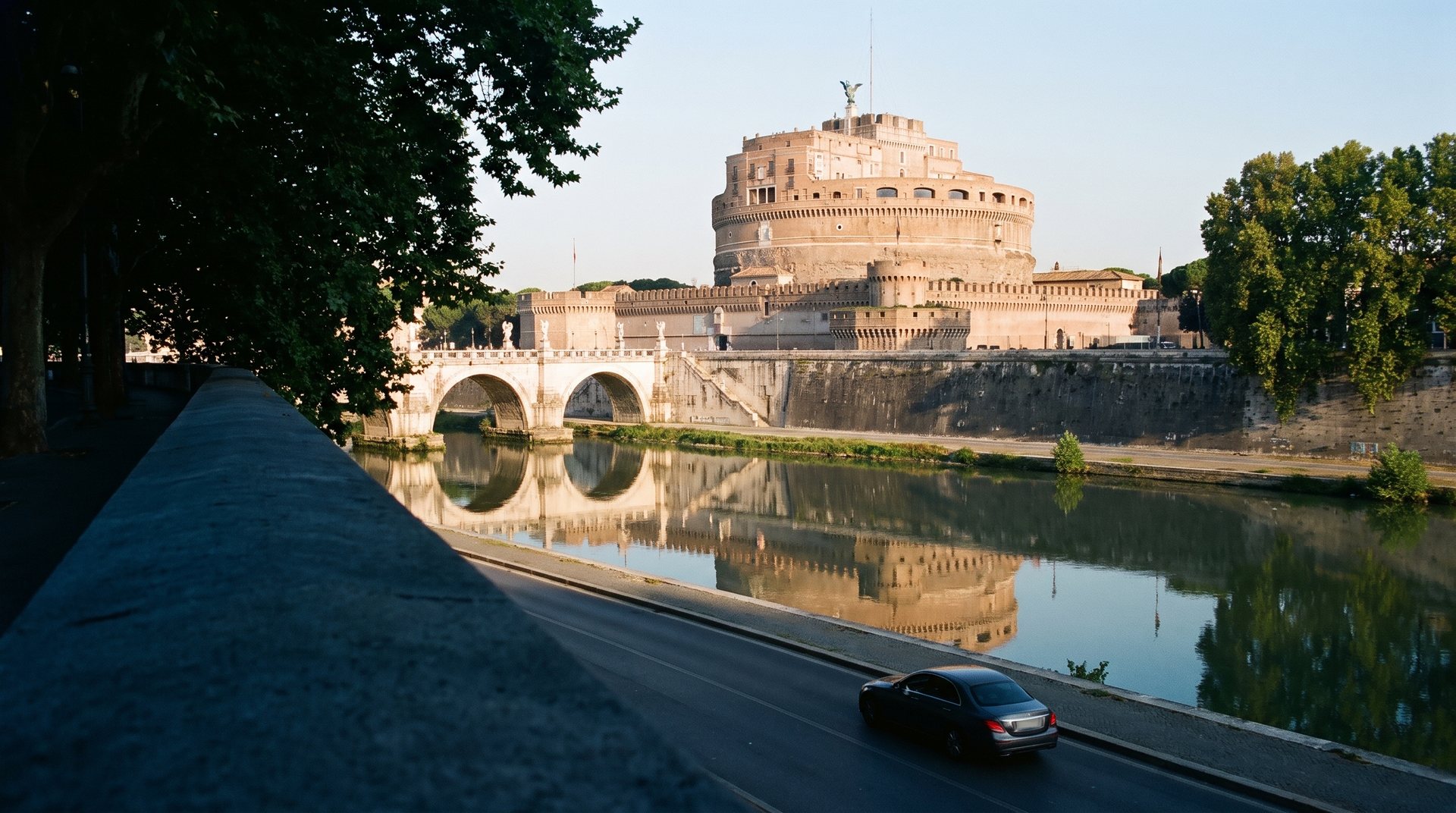
Rome. Thirty minutes from Ciampino to the centre, with every drop off planned around the old city.
Ciampino is close and quick, and we time every flight around its eleven o'clock closing. The historic centre is closed to most traffic during the working day, so we plan each drop off and collection around it before you land.
At a glance
What you need to know
- The business aviation airportCiampino (CIA)About 12 km south south east of the centre, with its own general aviation terminal and customs and immigration on site. Open 06:00 to 23:00 local, seven days a week.
- The alternativeFiumicino (FCO)About 30 km south west. Takes general aviation only during Ciampino's night closure, and there is no dedicated business aviation terminal, so passengers clear through the main building.
- Parking, not slotsPrior permission requiredPrivate flights do not need a slot at Ciampino, but permission and an aircraft parking stand do, requested through the handler. In the summer season that is a matter of days in advance, not hours.
- Driving in the centreZTL and Fascia VerdeThe historic centre is a limited traffic zone on weekdays and Saturday afternoons. A separate low emission zone covers everything inside the ring road and is judged on the vehicle, not the clock.
Checked in September 2026. Airport hours and Rome's traffic zones are set by ENAC, Aeroporti di Roma and the Comune di Roma and change from time to time, so we confirm them for the aircraft and the vehicle before every job.
Flying in
Ciampino is easy until eleven o'clock
Ciampino is the airport almost every private flight to Rome uses. It has a general aviation terminal of its own with customs and immigration in the building, and passengers are usually out of it in ten to twenty minutes. The drive into the centre is around twelve kilometres and takes thirty to forty minutes on an ordinary day, and up to an hour when the Appia and the ring road are busy, which is most weekday evenings. The handling agents on the general aviation apron are covered on the Rome private terminals page.
The two constraints are the clock and the concrete. Ciampino closes to traffic between 23:00 and 06:00, so a late dinner in Rome and a midnight departure do not go together. If the aircraft genuinely has to move in those hours, it operates from Fiumicino instead, where there is no business aviation terminal and clearing through the main building takes longer. The second constraint is aircraft parking, which is finite and goes early between May and September. We ask for your dates as soon as you have them for exactly that reason, even when nothing else about the trip is settled. If your aircraft is large, a stop in Milan or Naples sometimes solves a Rome problem better than Rome does.
Journey times
From central Rome by road
| To | Quiet roads | Busy periods |
|---|---|---|
| Ciampino (CIA) | 30 to 40 minutes | 50 to 70 minutes |
| Fiumicino (FCO) | 35 to 50 minutes | 60 to 90 minutes |
| Castelli Romani and Frascati | 40 to 55 minutes | 1 hour 15 or more |
| Naples | 2 hours 15 to 2 hours 45 | 3 hours 15 or more |
| Sorrento and the Amalfi Coast | 3 hours 15 to 4 hours | 5 hours in August |
| Florence | 3 hours to 3 hours 30 | 4 hours or more |
| Southern Tuscany and the Val d'Orcia | 2 hours 15 to 2 hours 45 | 3 hours 15 or more |
| Umbria, Assisi and Perugia | 2 hours to 2 hours 30 | 3 hours or more |
Realistic ranges, not promises. Outside London and Manchester our cars are arranged through operators we know, and you still deal with one contact at Odyssey.
Driving here
Two sets of rules, and neither is about traffic
Rome runs two overlapping restrictions that visitors constantly confuse. The ZTL of the centro storico is a limited traffic zone: unless a vehicle is registered for it, it cannot pass the cameras on weekdays between 06:30 and 18:00, or on Saturday afternoons. Trastevere, Testaccio, San Lorenzo and the Tridente have ZTLs of their own with different hours, several of them at night rather than during the day. The Fascia Verde is something else entirely, a low emission zone covering the whole city inside the ring road, judged on the vehicle's emissions class rather than on the time of day, and suspended on Sundays and public holidays.
In practice this decides both the vehicle and the plan. A modern executive saloon or people carrier clears the emissions zone without difficulty. The limited traffic zones are a matter of registration and routing, and both are ours to handle, not yours. What they mean for your day is that the car frequently cannot come to the door. Most of the good addresses in the centre sit inside a ZTL and are reached on foot from a setting down point a few minutes away, and the difference between an elegant arrival and a frustrating one is a chauffeur who has already worked out which corner that is.
The other thing worth knowing is that Rome's centre is genuinely small. Walking from the Spanish Steps to the Pantheon takes a quarter of an hour. A car earns its keep in Rome at the edges of the day, on the run to and from the airport, out to the Appia Antica or the Castelli, and on the long drives north and south. In between, it waits.
What people book
How Rome is usually run
- The morning flight into Ciampino, a car at the general aviation terminal, and the first meeting before eleven
- A chauffeur at your disposal for the day, set down and collected at agreed points outside the limited traffic zones
- Airport and station transfers for a family arriving in pieces over two days, tracked rather than guessed at
- The drive south, Rome to Naples and on to the Amalfi Coast, taken as one leg rather than broken by a train
- A week that begins in Rome and ends in Tuscany or Sicily, with the ground legs planned around where the aircraft can park
- Group travel in a V-Class, which is also the easiest vehicle for the narrow approaches to the centre
The calendar
When Rome is hard work
Rome's busy season is long rather than sharp. From Easter until late June and again through September and October the centre is full, the Vatican queues run round the block and the drive in from Ciampino is reliably at the slow end of the range. August is the opposite and always surprises people: the Romans leave, a great many restaurants and offices close for two or three weeks, the city is quiet and extremely hot, and the roads south to the coast are the worst they will be all year because everyone else is on them too.
Beyond the season, the events that actually move traffic in Rome are civic rather than commercial. State visits, papal events, marathons and demonstrations close streets across the centre at short notice, and they are not something you can plan for in advance. What we can do is watch for them, know the alternative approaches, and move a collection point rather than let a car sit in a closed street.
Around the trip
Related pages
Airports and aircraft
Elsewhere in Italy
Request a quote
Tell us the dates and the diary
Dates, how many of you, where you need to be and when. We come back with aircraft options, the airport we would use, the cars on the ground and an honest view of what the week will do to the roads.
Prefer to talk? +44 2030 048300 or WhatsApp, at any hour.
Questions people ask
About Rome
Can we depart Rome after midnight?
Not from Ciampino, which closes to traffic from 23:00 until 06:00. Fiumicino takes general aviation in those hours instead, but there is no business aviation terminal there, so allow longer on the ground.
Can the car drop us at the door in the centre?
Often not. Much of the historic centre is a limited traffic zone on weekdays and Saturday afternoons. Your chauffeur sets you down as close as the zone permits, which is usually a walk of a few minutes, and is back at that point when you ask.
Are the traffic zone permissions and charges your problem or ours?
Ours. We put a compliant vehicle on the job and deal with the registrations and the routing. You will not be asked to register anything.
Are these your own cars?
Our own cars and chauffeurs are in London and Manchester, and a trusted global network covers everywhere else. In Italy we arrange them through operators we know and run them to the same standards, with one contact at Odyssey from your front door onwards.
Can the same car take us on to Naples, the Amalfi Coast or Tuscany?
Yes, and for those journeys it is usually better than flying. Send the whole itinerary and we quote the legs together.
We deal with problems before you know they exist