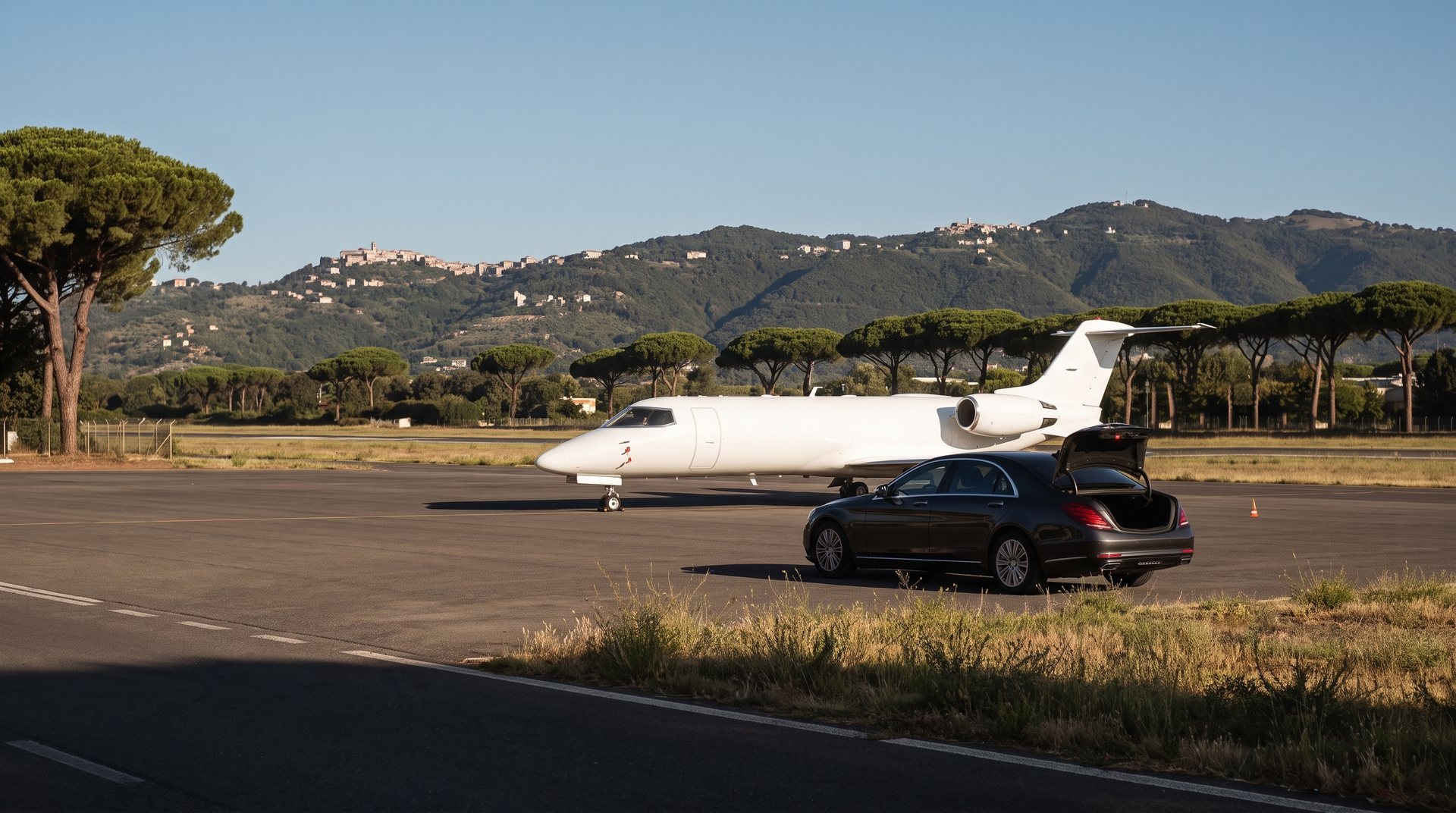
Rome Ciampino. Met at the private terminal and in central Rome in thirty to forty minutes.
Ciampino is where business aviation lands for Rome. The flying is the easy part. What shapes the day is the airport's night closure, the fight for a parking stand, and a historic centre that most cars are not allowed to enter.
The airport
Ciampino at a glance
- CodesCIA / LIRACiampino G. B. Pastine, about 12 kilometres south south east of central Rome, off the Via Appia Nuova.
- RunwayOne runway of about 2,208 metresComfortable for light, midsize and super midsize types, with performance to check on the largest jets in summer heat.
- Hours06:00 to 23:00 localThe airport is closed to commercial take offs and landings between 23:00 and 06:00 under a ministerial decree, with exceptions only for state, humanitarian and emergency flights.
- Private terminalA business aviation area on the fieldSignature Aviation, one of our aviation partners, runs an FBO here alongside other handlers. See Rome Ciampino private terminals.
Private flights do not need a commercial slot, but they do need somewhere to park, and prior permission is the normal discipline. When Ciampino has no movement availability, or the timing falls in the night closure, your operator will look at Fiumicino (FCO) instead, usually for a limited stay on the ground. None of that is your problem. It is worth knowing because it decides which side of Rome you land on.
Journey times
From Ciampino by road
| To | Quiet roads | Busy periods |
|---|---|---|
| Historic centre, Spagna and Via Veneto | 30 to 40 minutes | 50 to 70 minutes |
| Vatican and Prati | 35 to 45 minutes | 60 to 80 minutes |
| EUR business district | 25 to 35 minutes | 40 to 60 minutes |
| Castelli Romani and Frascati | 20 to 30 minutes | 35 to 50 minutes |
| Fiumicino (FCO) | 40 to 55 minutes | 1 hour to 1 hour 20 |
| Naples and the bay | 2 hours 15 to 2 hours 45 | 3 hours 15 or more |
| Florence | 3 hours to 3 hours 30 | 4 hours or more |
| Sorrento and the Amalfi Coast | 3 hours 15 to 4 hours | 5 hours in August |
Realistic ranges, not promises. The Grande Raccordo Anulare, Rome's ring road, is what decides the difference between the two columns. Cars in Italy are arranged through operators we know; our own fleet and our own chauffeurs are in London and Manchester, and a trusted global network covers everywhere else.
The bit that catches people out
The centre is closed to most cars
Rome's centro storico sits inside a limited traffic zone, the ZTL, enforced by camera. It runs on weekday mornings and afternoons and again on Saturday afternoons, and a wider low emission area covers much of the city. A car without the right authorisation that drives past a camera collects a fine weeks later, in the post, addressed to whoever hired it.
This is why we ask for the hotel or the address before we quote, not after. The local operators we use in Rome hold the permits their work requires, and where a street is genuinely closed to vehicles the answer is an agreed set down point a short walk away rather than a driver improvising at the barrier. Told in advance, it is a detail. Discovered on arrival with luggage and a dinner reservation, it is an hour.
The second thing worth planning is the return. Ciampino stops at 23:00, and a dinner that runs long in Trastevere does not move the airport. If your evening is likely to be late, say so when the flight is being planned, because the choice between Ciampino and Fiumicino is easier to make a week out than on the night.
Planning it well
What we ask about first
Five things that shape a Rome arrival.
- The exact address, not the district. Rome's restricted streets are decided door by door
- The tail number or operator, so the car is timed to the aircraft rather than to a filed time that has already moved
- Whether the aircraft is staying. In busy weeks it may reposition, which changes what the return looks like
- Luggage and passengers together. A full cabin of midsize jet passengers plus cases is often two cars, and it is cheaper to say so now
- What happens after Rome. A great many arrivals here carry straight on to Tuscany, the Amalfi Coast or the Castelli, and those are long, worthwhile drives that want planning
Onward
Around a Rome trip
Request a quote
Tell us the arrival
Date and time, tail number or operator, passengers and luggage, and the address in Rome. If you are going on to Tuscany or the coast the same day, tell us and we will plan the whole run rather than two separate legs. We come back with a clear price and an honest drive time. Nothing is booked or charged online.
Prefer to talk? +44 2030 048300 or WhatsApp, at any hour.
Questions people ask
About Ciampino transfers
Are these your own cars?
Our own fleet and our own chauffeurs are in London and Manchester, and a trusted global network covers everywhere else. In Rome cars are arranged through operators we know, and one person at Odyssey holds the whole movement together.
Can the car come to the aircraft?
Where the terminal permits it for your movement. Otherwise the car waits at the private terminal door. We confirm the arrangement before you land.
Ciampino or Fiumicino?
Ciampino for almost every private arrival: it is closer, quieter and set up for it. Fiumicino comes into play when Ciampino has no room, when the timing falls inside the night closure, or when a large aircraft makes it the sensible field.
Will the car take us to the hotel door?
Wherever the rules allow it. Parts of the historic centre are camera enforced or pedestrian only, so we agree the nearest permitted set down point in advance and tell you what the walk is.
Can you drive us on to Florence or Naples?
Yes, and many clients do. See long distance and multi day tours.
Can you arrange the aircraft as well?
Yes. See private jet charter and on demand charter.