Charter helicopters. For the sixty miles that cost three hours.
Battersea to Ascot in a quarter of an hour, or a race day at Silverstone that starts on the river instead of the M40. The four types you are most likely to be offered, and the honest limits of all of them.
At a glance
What a helicopter is actually for
- PassengersUsually 4 to 8The common charter types carry between five and twelve. Above eight, two aircraft are often the better answer than one large one.
- JourneyUnder an hour, as a ruleHelicopters earn their keep on the short hops where roads are slow. London to Ascot is about a quarter of an hour, London to Silverstone or Goodwood around half an hour.
- LuggageSoft bags, and not manyWeight and balance is real. Tell us what you are carrying at the start, because it decides the aircraft as often as the head count does.
- WeatherThe honest limitLow cloud and fog stop helicopters when they do not stop cars. Every plan needs a road alternative, and we hold one.
Helicopters are arranged with licensed commercial operators. Figures are typical for the types described and each quote names the actual aircraft.
Why it exists
The journey a car cannot win
Almost every helicopter charter we arrange replaces the same journey: sixty or seventy miles from London to somewhere with no station, on a day when everybody else is going to the same place. A Grand Prix weekend, a race meeting, a board meeting at a site in the middle of the country, a wedding at an estate. By road it is three hours and an unpredictable arrival. By air it is half an hour and a known one.
The second common use is the last leg of a longer trip. An aircraft lands at Nice and the party is on a yacht in Monaco twenty minutes later, or at Farnborough and in the Cotswolds before the traffic starts. The helicopter is not the journey; it is the piece of the journey that would otherwise ruin it.
The same person who arranges your cars and your aircraft arranges the helicopter, on one itinerary, so the timings hold together instead of being three separate bookings that meet by luck.
The four you will be offered
What each type is like
| Type | Typical passengers | Character | Best for |
|---|---|---|---|
| Leonardo AW109 | 5 to 6 | Light twin, fast, the traditional executive helicopter in Britain. Retractable gear and a slim cabin | One to five people, short hops, event days, where speed and cost matter |
| Airbus H145 | 6 to 8 | Light twin with a roomy square cabin, clamshell rear doors and a five bladed rotor on the current version | Luggage, skis, a group of six, and anything where getting in and out easily matters |
| Airbus H160 | 8 to 12 | The newest medium twin. Canted tail rotor and curved blades make it noticeably quieter than its predecessors | Larger parties, longer legs, and noise sensitive sites |
| Leonardo AW139 | 8 in a VIP cabin, up to 15 in transport layout | The medium twin most often seen in corporate and offshore work. The largest cabin in common charter use | Groups of eight or more, longer sectors, and offshore or over water flying |
Cabin layouts differ enormously between individual aircraft of the same type, and a VIP interior carries fewer people than a transport one. We send you the configuration of the aircraft you are being offered.
Where they land
In and around London
Landing sites are the part people underestimate. Britain allows more of them than most countries, but each has rules, and permission is never automatic.
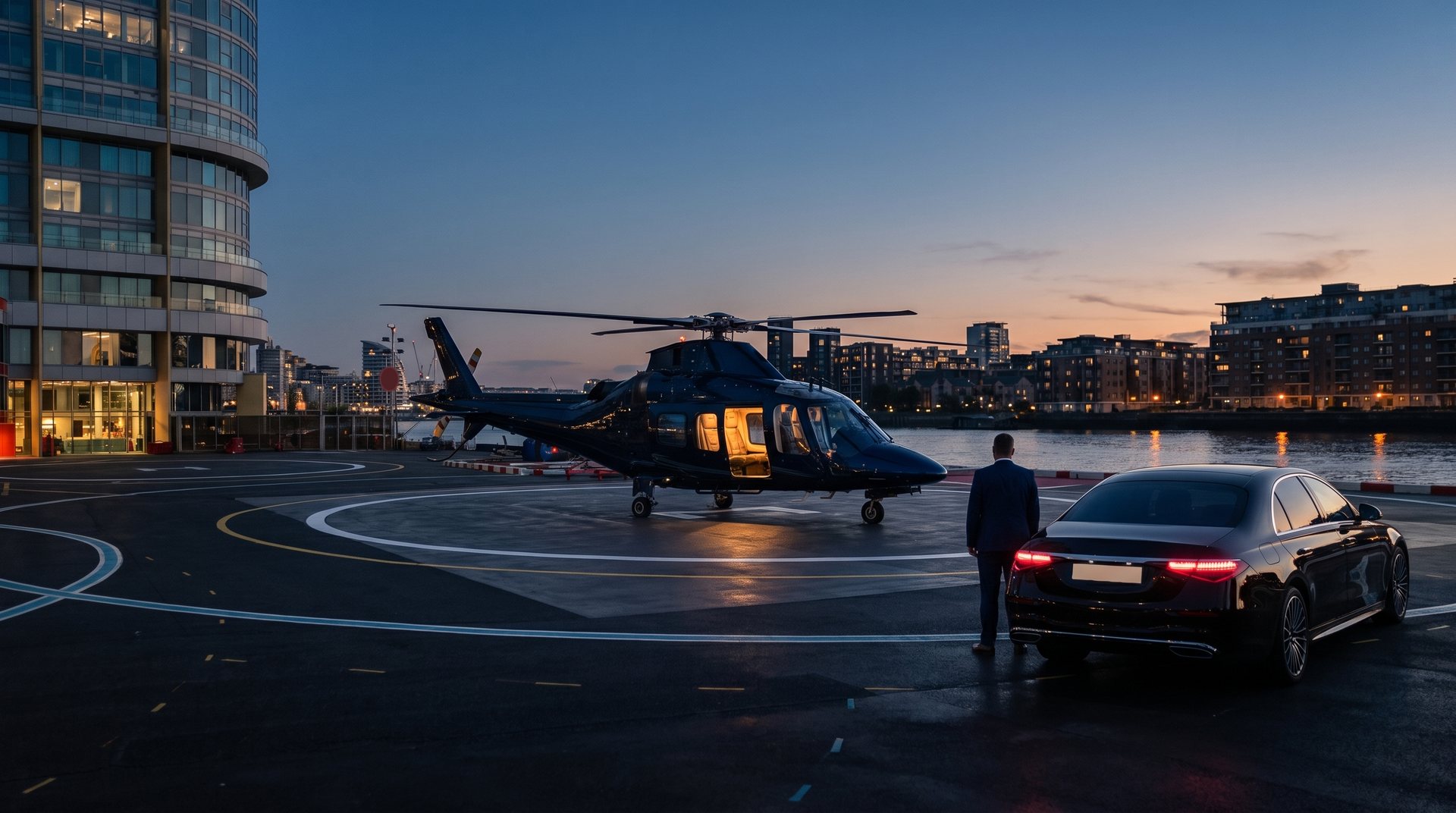
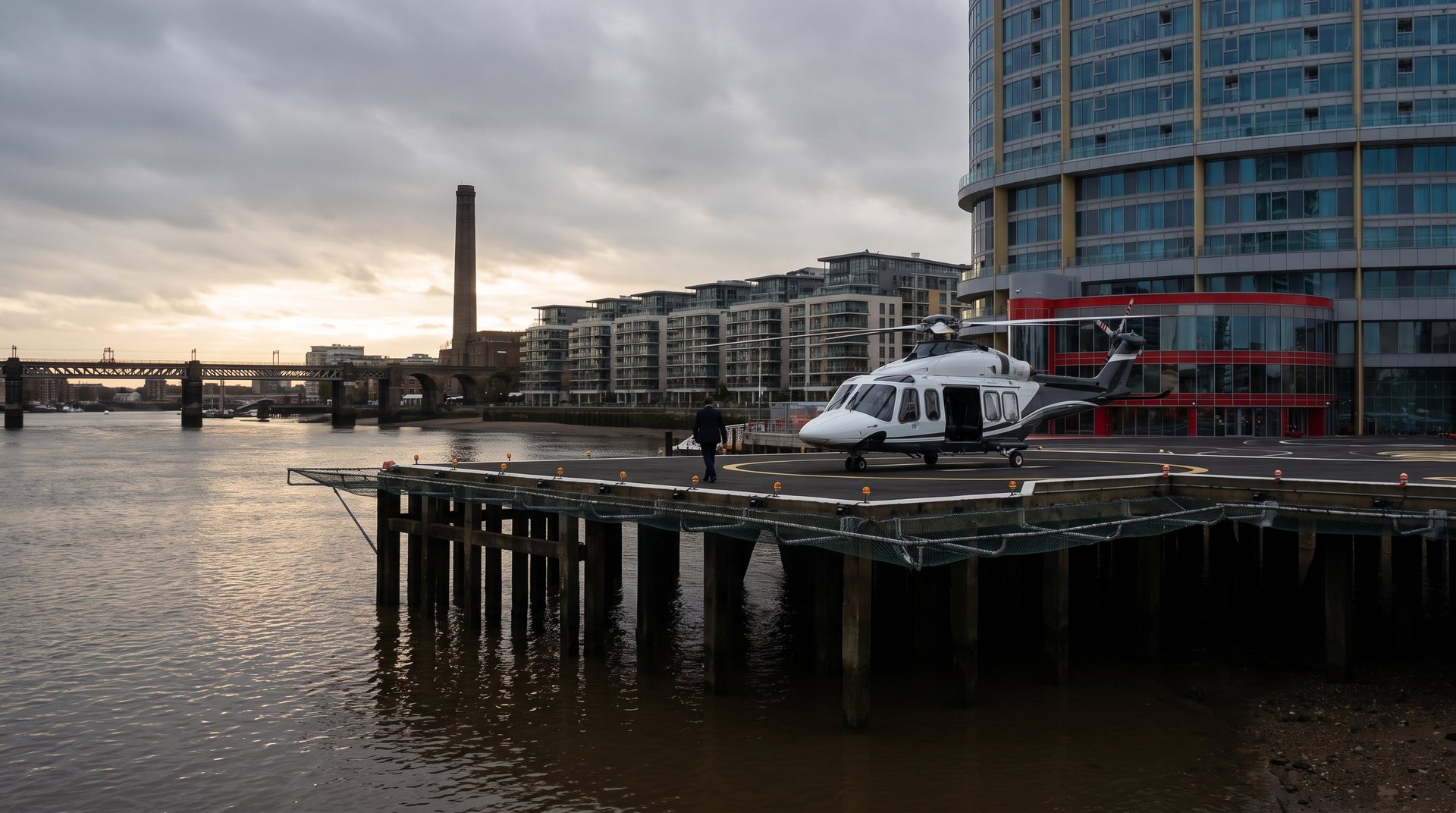
- The London Heliport at Battersea, on the south bank of the Thames between Wandsworth Bridge and Battersea Railway Bridge, is the only licensed heliport in central London and the usual starting point for a London flight
- Battersea arrivals and departures follow the river for noise reasons, and rotors may only run briefly on the ground, so boarding is brisk and organised rather than leisurely
- Denham Aerodrome, just inside the M25 near Gerrards Cross, is the practical alternative for the west of London and for anyone coming from the M40 or M4 corridor
- Private sites at houses, estates and hotels are often possible with the landowner's permission and the operator's survey, and need arranging well in advance rather than on the day
- Airports can be used as helicopter bases too, which is how most transfers to and from a private jet are flown
- Abroad, purpose built heliports such as Monaco work the same way and are usually the fastest way in
Event days
The three days the helicopter earns its fee
Event landing sites are run by the event, not by the operator. Slots are limited, paid in advance and usually non-refundable, and they go months before the event does.
British Grand Prix, Silverstone
Silverstone Heliport
No date in British motorsport generates more helicopter movements. Over a thousand flights across the weekend, marshalled and slotted, with arrivals every couple of minutes through race morning. Book months ahead.
Royal Ascot
Ascot Racecourse
A landing area close to the course with a short chauffeur transfer to the enclosures. Roughly fifteen minutes from Battersea, and among the busiest helicopter weeks of the British summer.
Goodwood
Goodwood Aerodrome
The Festival of Speed and the Revival both fly in to the estate's own aerodrome, with a transfer to the house and the paddocks. Half an hour from London and one of the busiest flying days of the year.
Said honestly
What can go wrong
Weather is the first thing. Helicopters fly visually far more than jets do, and a morning of low cloud over the Chilterns can stop a flight that would have taken half an hour. Any sensible plan for an event day has a car and a departure time held in reserve, and we hold both without being asked.
Weight is the second. Six adults, six overnight bags and a full fuel load is a calculation, not an assumption, and the honest answer is sometimes a larger aircraft or a second one. Telling us the luggage at the start avoids a difficult conversation on the apron.
The third is the landing site. A private estate needs the landowner's permission and a survey; an event site needs a slot bought in advance; a hotel needs its own arrangements. None of these are obstacles if they are dealt with early, and all of them are obstacles on the day.
Where they fly
Common helicopter journeys
Event days
Onward from an aircraft
Where people go
Both ends
A helicopter without a car is half a journey
Someone has to meet you at the landing site, and on an event day that site is a field with a marshal in it. We put the car where the aircraft actually lands and brief the chauffeur on the walk.
Request a quote
Tell us the date and the destination
How many of you, what you are carrying, where you are going and what time you need to be there. For an event we will tell you honestly whether slots are likely to be left. Nothing is booked or charged online.
Prefer to talk? +44 2030 048300 or WhatsApp, at any hour.
Questions people ask
About helicopter charter
Can we land at the house?
Often, with the landowner's permission and a survey of the site by the operator. It needs arranging in advance, and the operator decides whether the site is suitable, not us and not the owner.
How far ahead should we book for an event?
For Ascot or the Grand Prix, months. The landing slots are gone long before the aircraft are.
What happens if the weather is bad?
The operator makes the call, and it can come late. We hold a car and a realistic departure time as a matter of course, so that a cancelled flight is an inconvenience rather than a missed day.
How much luggage can we take?
Soft bags, and fewer than you would expect. Weight, balance and fuel are calculated for every flight, so tell us what is coming at the start and we will match the aircraft to it.
Which type should we ask for?
For one to five people and a short hop, an AW109. For six with luggage, an H145. For eight or more, an H160 or an AW139. We will recommend one and explain why, rather than simply offering what is free.