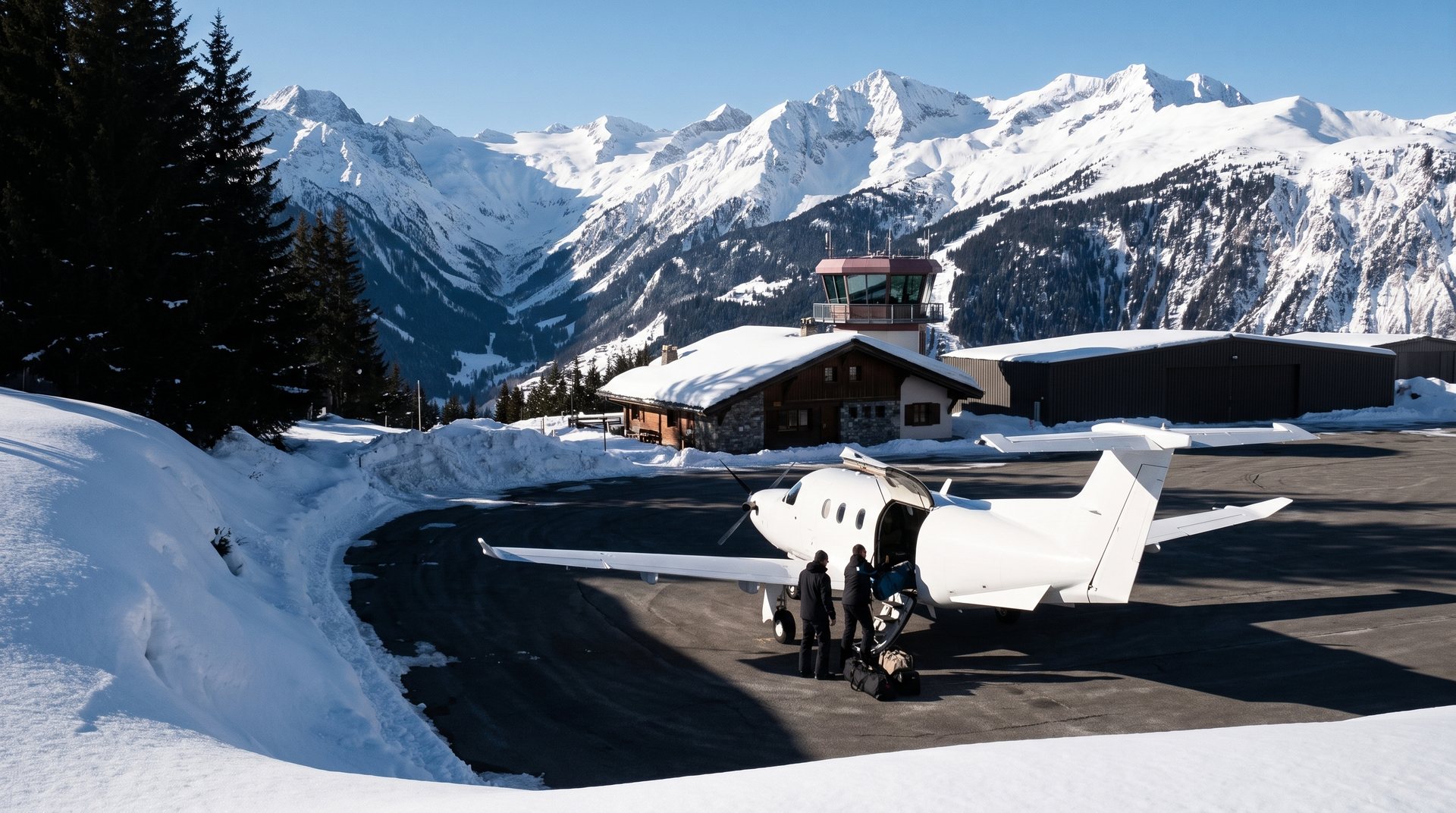
Turboprops. The only aircraft that can land there.
Six to nine people into runways a jet cannot use: alpine valleys, island strips, grass, and the field ten minutes from the house. Slower in the air, and frequently earlier at the door.
PassengersTypically 6 to 9Nine is the maximum on the common types and six to eight is the comfortable number with luggage.
RangeRoughly 1,000 to 1,800 nautical milesWith every seat filled, plan on the lower end. Most turboprop charters in Europe are under three hours.
CabinSeated headroom, and a big doorPressurised on the types used for passengers, with a cargo door on some that swallows skis, cases and equipment a jet hold will not take.
RunwayShort, steep, high or unpavedThe whole point of the class. Fields a light jet cannot use are routine, and some can work off grass and gravel.
Category guidance. Figures are typical for the class rather than promises about a particular aircraft, and every quote names the actual aeroplane.
What it is for
Chosen for the runway, not for the aeroplane
Almost nobody asks for a turboprop. They ask to get to Gstaad, or to St Barths, or to an island in the Hebrides, or to a shooting lodge with a strip on the estate, and the turboprop is the only aircraft that will do it. On those journeys the class is not a compromise: it is the answer, and a jet simply cannot be part of the conversation.
The second reason is the short sector. Under about five hundred miles a jet spends most of the flight climbing and descending, and the speed advantage on the day is often fifteen or twenty minutes rather than an hour. If the turboprop can use an airfield nearer both ends, it wins on the door to door time even though it is slower in the air.
The third is load. Some turboprops have a cargo door and a square cabin, which makes skis, boards, bicycles, camera cases and shoot kit straightforward in a way that a light jet's tapered hold never is. Aircraft are arranged with licensed commercial operators, and we confirm the type, the operator and the crew's experience of the field before you commit.
Examples
Aircraft you are likely to be offered
Aircraft
Typical seats
Typical range
Character
Pilatus PC-12 and PC-12 NGX
6 to 9
About 1,300 nm with the seats full
A single engine Swiss aircraft with a large cargo door, happy on short and unpaved strips
Beechcraft King Air 350i and 360
7 to 9
Up to about 1,800 nm
Twin engine, the most widely available turboprop in European charter
Cessna 208 Caravan and Grand Caravan
6 to 9
Shorter sectors only
Unpressurised, so it flies low. The workhorse of island and Caribbean flying
De Havilland Twin Otter
Up to 19 in airline layout
Short sectors
Extremely short field performance, used on the hardest island runways
Daher TBM 960 and Piper M700
4 to 5
About 1,300 to 1,700 nm
Fast single engine aircraft, closer in feel to a very light jet
Published range figures assume still air and a light load. What an aircraft will actually do on the day depends on the wind, the load, the elevation and the runway at each end.
Range on the map
Where the class reaches
Drawn from Farnborough as true circles on the globe. The solid ring is the top of the class's typical range and the dashed ring is what most of its aircraft can plan on. Change the departure to see the reach from anywhere.
Published range85%, still-air planning
Turboprops from Farnborough Airport (FAB). The solid ring is the top of the class's published range, 1,800 nautical miles; the dashed ring is 85% of the bottom of it, 850 nautical miles, which most aircraft in the class can plan on non-stop. Winds, payload and reserves reduce real range, so every trip is checked on the day.
The fields that need one
Where a jet is simply not allowed
Gstaad Saanen sits on the valley floor at about 1,001 metres with a runway of 1,400 metres, no instrument approach and prior permission required for every movement. Turboprops and the smallest jets use it, and the weather in the valley decides whether the flight happens at all.
St Barths has a runway of about 646 metres with a steep approach over the ridge at Col de la Tourmente and daylight operations only. Small turboprops and light aircraft are the only types that operate there, flown by pilots who hold a specific qualification for the field. Arriving guests normally fly into St Maarten on a larger aircraft and transfer for the last ten to fifteen minutes.
Courchevel's altiport is the extreme case: a runway of about 537 metres with a gradient close to nineteen per cent and no go-around once committed. Commercial passenger flights there are limited to a single specially authorised operator, so for almost every client the practical answer is Chambery or Grenoble and a car up the mountain. We will tell you that at the enquiry rather than sell you an aeroplane that cannot land.
They are slower. Roughly 260 to 320 knots against 400 or more for a jet, which shows on any sector over about two hours
They fly lower, so more of the flight is in the weather rather than above it. On a rough day passengers notice
Propeller noise is real, and the cabins are quieter than they used to be rather than quiet
Single engine turbine aircraft such as the PC-12 have been allowed on commercial flights in cloud and at night across Europe since 2017, but under additional operator approvals. If your policy is twin engine only, tell us and we will only offer twins
Alpine and island fields have prior permission, daylight, weather and parking constraints that decide the day. A confirmed aircraft is not the same as a confirmed landing, and we say so before you travel
For anything over about three hours, or for a transatlantic leg feeding an island hop, the answer is a jet for the long sector and a turboprop for the last one
Go a size up
When a jet is the better answer
Most European trips of more than about two hours are simply nicer in a jet, and not always dearer.
Sectors over about 500 miles
Airfields with a normal runway at both ends
A cabin above the weather for nervous passengers
Connecting straight on to a long sector the same day
Type the two ends of the trip, and the number travelling if you know it. You will see the distance, a realistic time in the air, and which classes and aircraft can fly it without a stop, with this class marked.
Distances are great circle, the shortest line over the earth. Non-stop is judged against 85% of each aircraft's published still-air range, which leaves a sensible margin for reserves, wind and load. Times are a planning range for the time in the air, not a schedule. Aircraft are arranged with licensed commercial operators, and every quote is checked against the actual aircraft, the load and the forecast for your date.
Request a quote
Tell us the field as well as the route
If you already know the airfield, name it: alpine and island strips have permission, daylight and parking rules that shape the whole plan. If you only know the house or the resort, tell us that instead and we will work out which field is genuinely usable on your date. Nothing is booked or charged online.
No. The types used for passenger charter are certified and flown to the same commercial standards, and crews operating into demanding fields are specifically qualified for them. If you would prefer twin engines rather than a single, say so and we will only offer twins.
Can we fly straight into Courchevel?
In practice, no. The altiport runway is about 537 metres with a very steep gradient and no go-around, and commercial passenger flights are restricted to one specially authorised operator. Almost every client flies to Chambery or Grenoble and drives up, and we arrange the car through operators we know.
Will our skis fit?
Usually yes, and this is where the class shines. A cargo door and a square cabin take skis, boards and boot bags that a light jet's hold will not. Tell us the exact kit when you enquire.
How long is the flight compared with a jet?
On a one hour sector, nearly the same. On a three hour sector, perhaps forty minutes longer. Against that, the turboprop may leave from an airfield twenty minutes from your house rather than an hour, so we compare door to door rather than wheels up to wheels down.
Is it noisy?
Noticeably more than a jet, particularly on climb. Pressurised types such as the PC-12 and King Air are perfectly civilised at cruise. An unpressurised Caravan on a Caribbean hop is a different experience, and an enjoyable one.
Can you arrange the car at the other end?
Yes. Our own chauffeurs cover London and Manchester, and elsewhere cars are arranged through operators we know, including alpine transfers with the right winter equipment for the country and date. See private jet and FBO transfers.