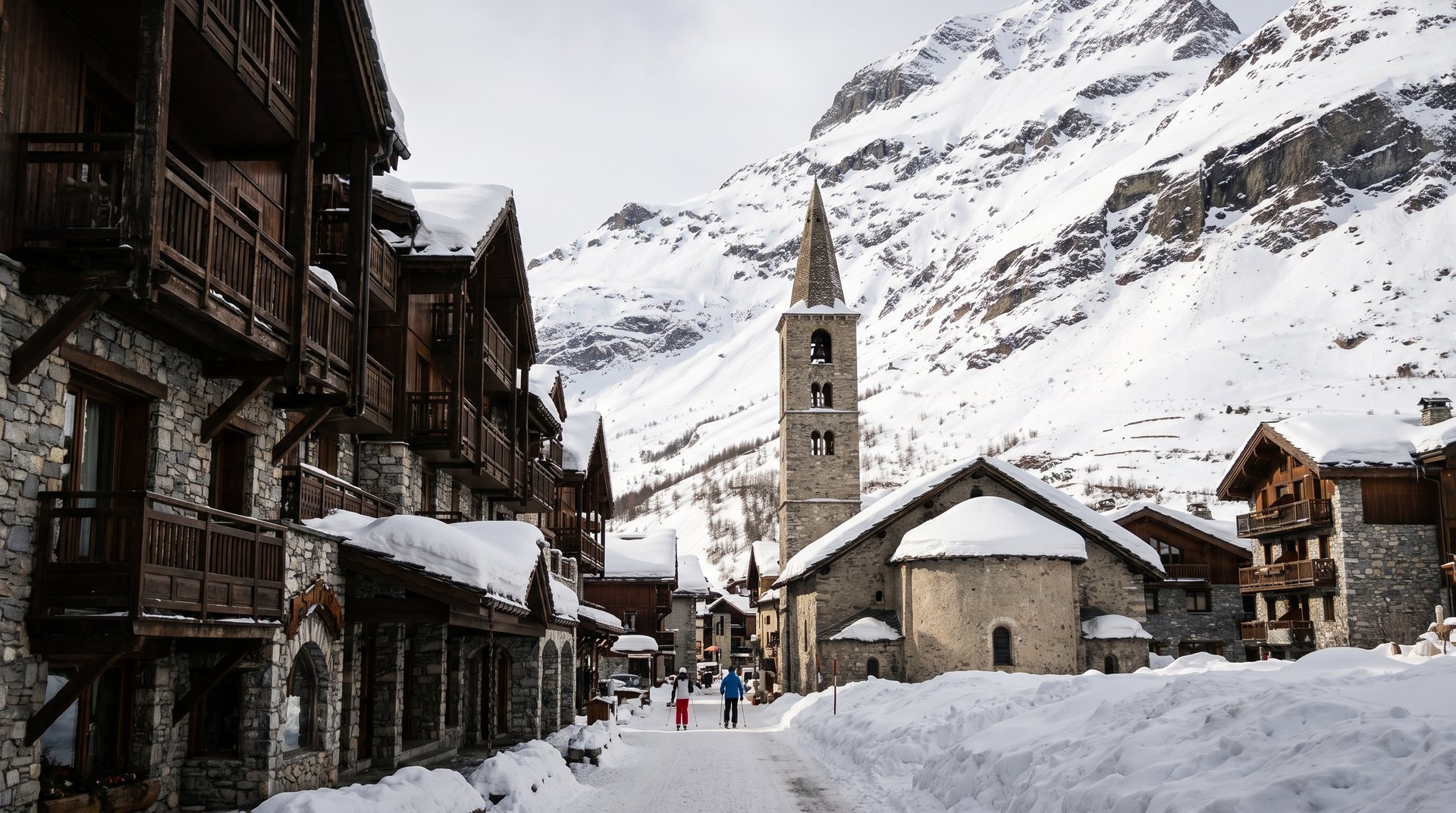
Val d'Isère. Skiing from late November to May, and the long valley road timed around your arrival.
The season here runs from the end of November to the start of May, which is the reward. The price is a long valley road that every arriving car in the Tarentaise uses on the same day of the week.
The resort
Altitude is the whole argument
Val d'Isère sits at 1,850 metres at the top of the Tarentaise, with skiing that runs from about 1,550 metres up to around 3,450 at the Pointe du Montet. Roughly sixty per cent of the pistes are above 2,200 metres and there are two glaciers in the area, which is why the resort opens at the end of November and is still running at the start of May when almost everything else in the Alps has closed.
The resort is strung along one road. La Daille is the first thing you reach, at the bottom of the funicular, with the classic downhill course dropping into it. Val d'Isère centre is a couple of kilometres further on, and Le Fornet is beyond that again, up the valley towards the Col de l'Iseran, quieter and higher and with its own cable car. Where you stay changes the last five minutes of the transfer and the walk to a lift, and it is worth telling us which before anything is booked.
For 2026 and 2027 the season runs from 28 November 2026 to 2 May 2027, with the opening weekend on 28 and 29 November. The Critérium de la Première Neige, the World Cup meeting the resort has held since the 1950s, returns in December, with the 2026 races on 12 and 13 December.
At a glance
What you need to know
- The resort1,850 m, skiing to about 3,450 mLa Daille, the centre and Le Fornet, strung along one road up the valley.
- Season28 November 2026 to 2 May 2027Two glaciers and around sixty per cent of the pistes above 2,200 metres.
- Closest jet airportChambéry (CMF)About 1 hour 50 to 2 hours 15 by road in normal winter conditions.
- The last stretchAbout 30 km from Bourg-Saint-MauriceRoughly 45 minutes of climbing, and the part of the journey that decides your afternoon.
Season dates as published by the resort and checked in September 2026. Transfer times are realistic ranges, not promises.
Getting there
Airports and typical transfers
| Airport | By road to Val d'Isère | Why you would choose it |
|---|---|---|
| Chambéry Savoie Mont Blanc (CMF) | About 1 hour 50 to 2 hours 15 | The closest airport that takes business jets. A mountain approach with weather minima, so an alternative is always agreed before departure. |
| Geneva (GVA) | About 3 hours to 3 hours 30 | The dependable choice, with the capacity and the fewest weather closures, at the cost of the longest drive. See Geneva private terminals. |
| Lyon Saint-Exupery (LYS) | About 2 hours 30 to 3 hours | Motorway for most of the way and rarely closed. A sensible fallback when the Alpine airfields are marginal. |
| Grenoble Alpes-Isere (GNB) | About 2 hours 10 to 2 hours 45 | Useful in the winter season, with less traffic on the approach than Geneva. |
| Bourg-Saint-Maurice | About 45 minutes | Where the valley narrows and the climb begins. Also the railhead, for anyone arriving by train. |
Realistic ranges in normal winter conditions, not promises. On a February Saturday the run from Albertville through Moûtiers and Bourg-Saint-Maurice can add well over an hour. Outside London and Manchester our cars are arranged through operators we know, with winter tyres and chains.
The valley road
Thirty kilometres that decide the day
Everything about arriving in Val d'Isère comes down to the road above Bourg-Saint-Maurice. It climbs some thirty kilometres through Sainte-Foy and past the Tignes turning, it is single carriageway, and it is the only way in. In good conditions it takes about three quarters of an hour and it is a beautiful drive. In snow, or behind a coach, or on the wrong Saturday, it is not.
Saturday is the problem, and it is a predictable one. The whole Tarentaise changes over on the same day, so the flights, the airport, the motorway from Albertville and the valley road all peak together between roughly mid morning and late afternoon. The two ways to beat it are to arrive very early or comparatively late, or to take a different day altogether. A Sunday to Sunday week is a small change to the diary and a large change to the journey.
The other factor is the weather. Heavy snow slows the climb considerably and the road is occasionally closed for avalanche control, at no notice. It is one more reason we plan the return with slack in it rather than to the minute.
By air
No altiport, but a helipad
Unlike Courchevel and Méribel, Val d'Isère has no altiport for fixed wing aircraft. What it has is a helipad at La Daille, at around 1,800 metres at the entrance to the resort, which is where helicopter transfers land. There is a helicopter base at Bourg-Saint-Maurice as well, which is often the practical staging point for the Tarentaise.
That makes the helicopter a genuine option for the last leg rather than a novelty. It removes the valley road from the equation entirely, in daylight and acceptable visibility. The caveats are the ones that apply everywhere in the Alps: mountain weather stops it without consulting your diary, and capacity in the peak weeks is committed early, so it is asked about at the same time as the aircraft rather than the week before.
The rest of the plan is the usual shape. A jet into Chambéry with Geneva, Lyon or Grenoble agreed as the alternative, a car meeting it wherever it actually lands, and the last leg by road or by helicopter depending on the day. See helicopter charter.
Local realities
What experienced visitors do here
- Move off Saturday if the dates allow. Nothing else you do improves the journey as much
- If it must be Saturday, land early in the morning or in the late afternoon and accept one of the two
- Tell us which village you are in, La Daille, the centre or Le Fornet. It is the last five minutes and the first walk of every morning
- Agree the fallback airport before you leave. Chambéry is the closest and the most weather dependent
Around the trip
Related pages
Routes and airports
Other resorts
Request a quote
Tell us the week and the chalet
Dates, how many of you, where you are staying in the resort, and how many sets of skis. We come back with aircraft options, the road and helicopter plans side by side, the fallback airport, and an honest view of what the day of the week will do to the journey.
Prefer to talk? +44 2030 048300 or WhatsApp, at any hour.
Questions people ask
About Val d'Isère
Can we fly into the resort?
Not in a fixed wing aircraft. Val d'Isère has no altiport. Helicopters land at the La Daille helipad at around 1,800 metres, in daylight and acceptable visibility, and jets use Chambéry, Geneva, Lyon or Grenoble.
How long is the drive from Geneva?
About three hours to three and a half in normal winter conditions, and longer on a Saturday in February. Chambéry is nearer at around two hours, with the weather caveat that comes with a mountain airport.
Why does everyone talk about Saturday?
Because the whole Tarentaise changes over on it. The flights, the airport, the motorway and the single valley road above Bourg-Saint-Maurice all peak together. Arriving early, arriving late or choosing another day are the only real answers.
When does the resort open and close?
For 2026 and 2027, from 28 November 2026 to 2 May 2027. The altitude and the two glaciers are why the season is longer here than almost anywhere else in the Alps.
Are these your own cars?
Our own cars and chauffeurs are in London and Manchester, and a trusted global network covers everywhere else. Alpine transfers are arranged through operators we know and run to the same brief, and you deal with one contact at Odyssey from the front door to the chalet.
One contact, wherever you are