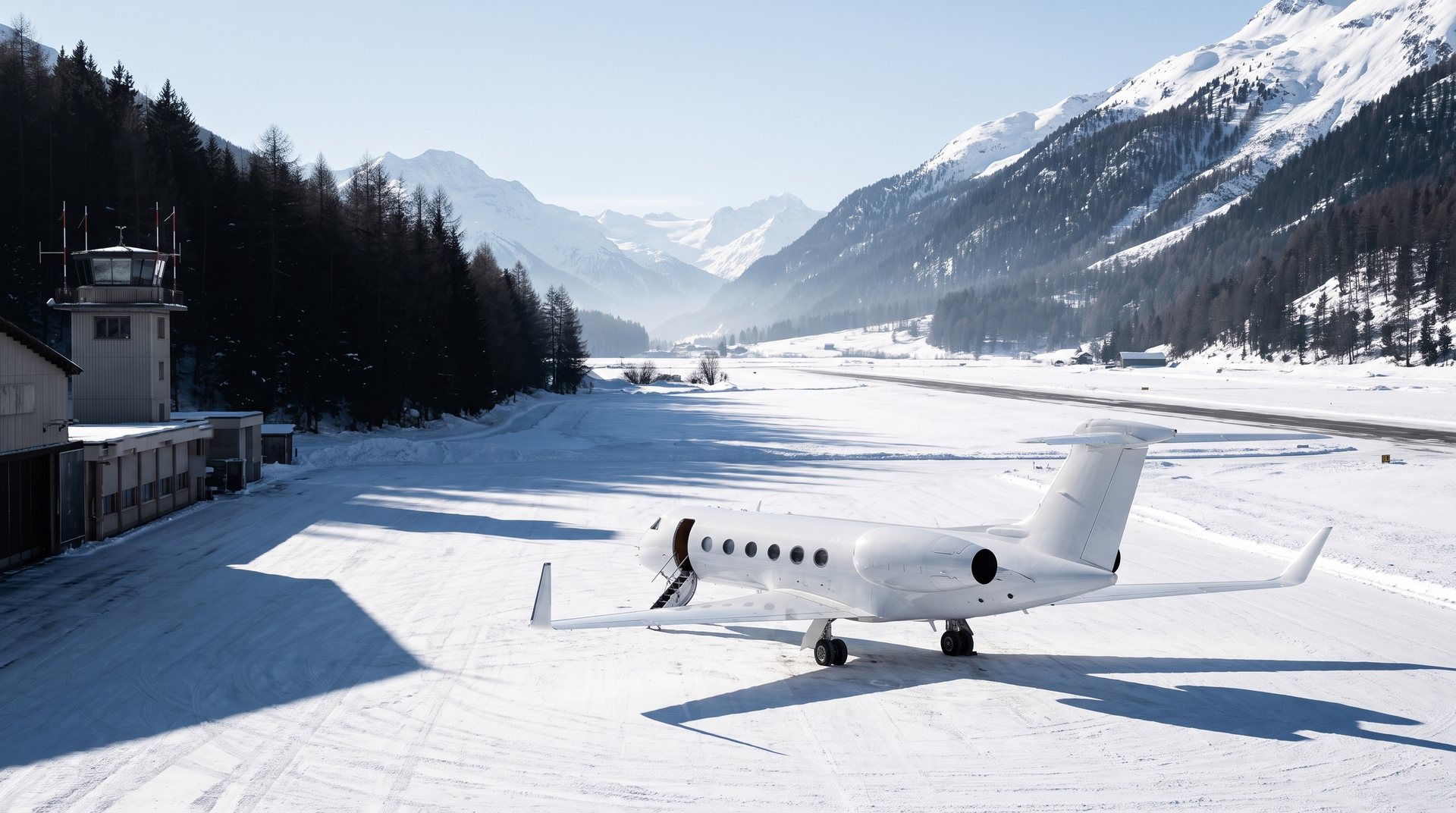
Challenger 350. The one most people should be flying.
Nine people, a flat floor you can walk down, a hold you can reach in flight, and enough range to leave Europe behind. It is the aircraft European charter departments are asked for more than almost any other, and the reasons are all practical.
At a glance
What it carries
- PassengersUsually 8 or 9A club four forward and a club four or a three place divan aft. Nine is the sensible working maximum; the type is certified for more.
- RangeAbout 3,200 nautical milesBombardier's figure with eight passengers and instrument reserves. Roughly six and a half hours in the air in still conditions.
- Cabin23 ft 7 in long, 7 ft 2 in wide, 6 ft 1 in highFlat floor from front to back, so nobody steps over a dropped aisle, and full standing headroom for most people.
- BaggageAbout 106 cubic feet, reachable in flightRoom for nine people with golf clubs or ski bags, and you can get at it while airborne, which almost nothing smaller allows.
Manufacturer figures for the type. Layouts differ between individual aircraft, so we send you the floor plan of the one you are being offered.
Why it is everywhere
The aeroplane that settled the argument
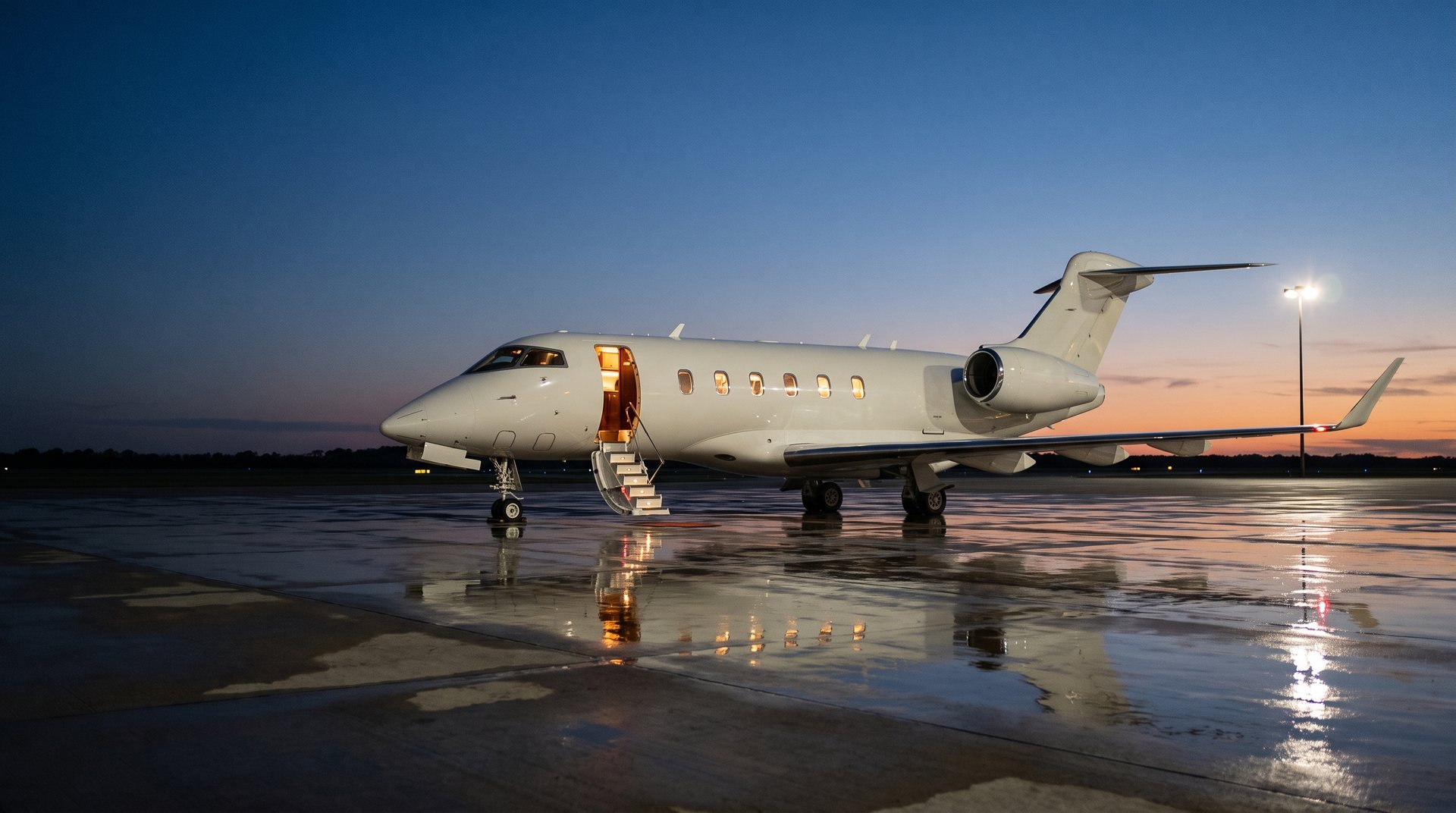
Ask any charter department in Europe which aircraft they are asked for most and the answer is usually this one. It is not the fastest, it does not have the longest legs in its class, and it is no longer in production. It simply does everything a European client actually does without asking anyone to compromise: a working day in Geneva, a family week in Sardinia, a board meeting in Madrid and back, a run to the Gulf when the wind is kind.
The flat floor is the detail that sells it. A midsize jet asks passengers to step down into a dropped aisle and to stoop at the door; the Challenger does neither. Add a hold you can reach at cruise, a cabin wide enough for a table that two people can genuinely work at, and a cabin crew member on most charters, and you have an aircraft that makes a six hour day ordinary.
The 350 left production in 2022, replaced by the Challenger 3500, which shares the airframe and the type rating and differs chiefly in the cabin. Hundreds of 350s remain in charter fleets across Europe, which is why availability is usually good and why a quote on a Tuesday for a Thursday is realistic on this type when it is not on many others. Aircraft are arranged with licensed commercial operators.
Good for
When to choose it
- A group of eight or nine with real luggage, where a midsize jet would mean leaving bags or splitting the party
- Anything from London that takes four to six hours: the Canaries, Greece, Turkey, Morocco, the north of Scandinavia
- A working flight, where two people need a table and the others need to be left alone
- Ski weeks, because the hold takes boards and boots without the packing puzzle that smaller jets set you
- Trips where a cabin crew member and hot catering matter, which is normal in this class and rare below it
- Short notice, because there are simply more of these aircraft available in Europe than of anything comparable
Honest comparison
The 350 against its neighbours
| Aircraft | Typical seats | Published range | Where it differs |
|---|---|---|---|
| Challenger 350 | 8 to 9 | About 3,200 nm | The widest ordinary choice in the class, flat floor, big accessible hold, and easy to find |
| Challenger 3500 | 8 to 9 | About 3,400 nm | The current production successor. Same airframe and rating, newer cabin, fewer of them about |
| Embraer Praetor 600 | 8 to 9 | About 4,000 nm | Noticeably longer legs, which matters if you are pushing towards the Gulf or the Atlantic |
| Citation XLS+ | 8 to 9 | Under 2,000 nm with a full cabin | A size down. Cheaper and better at short runways, but you stoop and the range is European only |
| Global 6000 | 11 to 13 | About 6,000 nm | A size up. Transatlantic in both directions in any season, with a bedroom |
Published figures in still air. See super-midsize jets for how the whole class compares, or choosing a jet category if you are starting from scratch.
Range on the map
How far it goes without stopping
The ring is the published range drawn as a true circle on the globe, which is why it bends on a flat map. Change the departure to see the reach from anywhere.
Challenger 350 from Farnborough Airport (FAB). The solid ring is the published range, 3,200 nautical miles; the dashed ring is 85% of it, 2,720 nautical miles, the still-air planning figure we use to leave a sensible reserve. Winds, payload and reserves reduce real range, so every trip is checked on the day.
Said honestly
Where the range runs out
London to Dubai is at the edge. Eastbound, with a light cabin and a helpful jet stream, it is a non-stop flight. With nine people, their luggage and a winter headwind, it can become a fuel stop in central Europe or the eastern Mediterranean. That is not a failure; a planned technical stop adds about an hour and is far better than a diversion. But you should hear it before you book, not at the airport.
The Atlantic is the other honest limit. Eastbound from the east coast of the United States is usually comfortable. Westbound to New York in the winter, with the jet stream against you, a stop in Ireland, Iceland or Canada is a real possibility on this type. If a non-stop both ways matters, the conversation moves to heavy jets.
Everything else Europeans normally do is well inside the aircraft. The Mediterranean, the Alps, the Canaries, North Africa, Scandinavia and the Atlantic islands are all comfortable with a full cabin.
Where it goes
Routes that suit it
Comfortable from London
Departure airports
On the ground
The car is where most trips go wrong
A six hour flight is undone by a driver who left before the aircraft landed. We watch the flight, hold the car and move the pick up ourselves, at both ends of the trip.
Request a quote
Tell us the trip and the date
Route, date, how many of you and what luggage. On this type we can usually say quickly what is free and where it is based, and we will tell you plainly if the sector is one the aircraft will not do non-stop on that day. Nothing is booked or charged online.
Prefer to talk? +44 2030 048300 or WhatsApp, at any hour.
Questions people ask
About the Challenger 350
Is the 350 old now that the 3500 exists?
No. It left production in 2022 and the 3500 is the same airframe with a newer cabin and the same type rating. A well kept 350 with a good operator is an excellent aeroplane, and there are far more of them available.
Can we stand up in it?
Most people can, at six feet one inch of cabin height, and the floor is flat end to end, which matters more than the number. Someone very tall will still duck slightly.
Will nine of us and our skis fit?
Yes, which is the main reason people step up to this type. The hold is around 106 cubic feet and you can reach it in the air.
Is there cabin crew on board?
On most charters in this class, and on longer sectors almost always. Confirm it when you choose, because it decides what catering is possible.
Can it get into the Alpine airports?
The valley airports such as Geneva, Chambery and Salzburg, yes, subject to the day and the operator's approvals. The mountain altiports are for much smaller aircraft or a helicopter for the last leg.

One contact, wherever you are