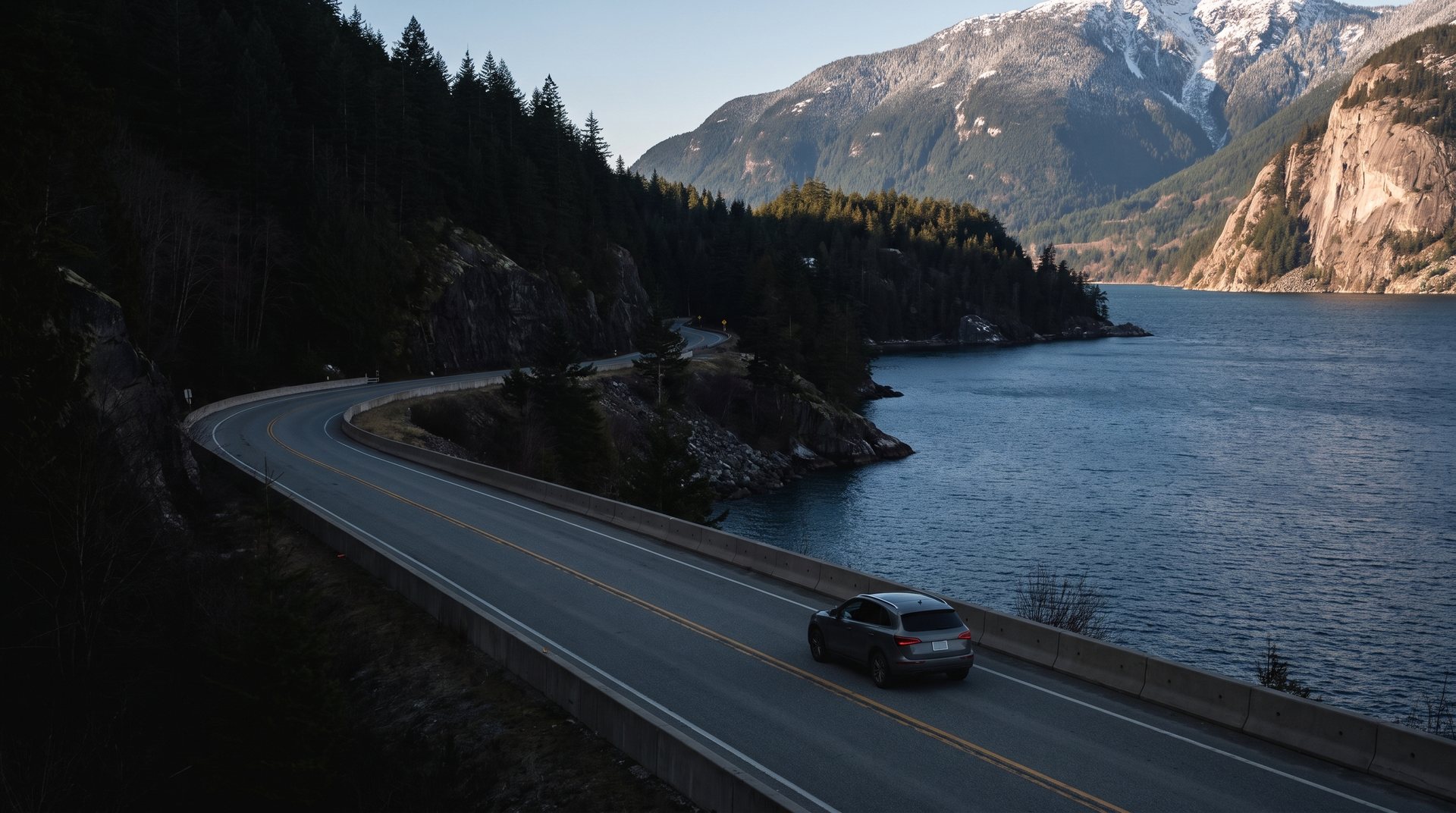
Whistler. One road in, and it is a beautiful one.
Every private arrival clears customs at Vancouver and then takes the Sea to Sky Highway north, about two hours of coastline and mountain. It is a genuinely lovely drive, and it is also the single point of failure in the trip.
The essentials
Whistler at a glance
- GatewayVancouver International (YVR)The arrival and customs point for essentially every private trip. Full business aviation handling on the field, and the airport is about 120 to 135 km from the resort.
- Road transferAbout 2 to 2.5 hoursHighway 99, the Sea to Sky, from Horseshoe Bay through Squamish. Winter weather, a Friday afternoon and an incident on the road all add to it.
- By helicopterAbout 25 to 40 minutesWeather and daylight dependent, and capacity is finite in the busy weeks. It is a real option rather than a certainty.
- Nearest airfieldPemberton Regional (CYPS)About 3,900 ft of asphalt, so turboprops and small types only, roughly 25 to 30 minutes north of the village by road.
Distances and airfield details checked in September 2026. Transfer times are realistic planning ranges, not promises.
Arriving
Why the jet lands at Vancouver
Whistler has no airport of its own. It has a floatplane base on Green Lake and a heliport, both of which matter, but a jet coming from London, New York or Los Angeles lands at Vancouver International, which is where a private arrival clears Canadian customs and immigration and where the handling, fuel and crew facilities are.
Pemberton Regional, about half an hour north of the village, is sometimes raised as a closer alternative. Its runway is short by jet standards, the approach is a mountain approach, and whether it is usable at all on a given day depends on the aircraft, the weather and the operator's own policy. It is a sensible answer for a turboprop on a clear day and a poor one for anything else, so we treat it as an option to be checked rather than a plan to be assumed.
See private jet charter, ultra long range jets, heavy jets, turboprops and how chartering works.
Getting there
The options, honestly compared
| Option | Typical time | When it is the right answer |
|---|---|---|
| Vancouver to Whistler by road | About 2 to 2.5 hours | The default, and the only one that works in any weather at any hour. Comfortable, scenic, and it carries the luggage. |
| Vancouver to Whistler by helicopter | About 25 to 40 minutes | When the schedule is tight and the weather is good. Daylight and visibility dependent, with real limits on baggage. |
| Turboprop into Pemberton, then road | Flight plus 25 to 30 minutes | Occasionally, for the right aircraft on the right day. Always confirmed with the operator before it goes in a plan. |
| Floatplane to Green Lake | Short hop | Seasonal and weather dependent. Charming rather than dependable, and not a way to move a group with ski bags. |
| Squamish stop en route | Adds 30 to 60 minutes | Worth it on a long inbound day if the group wants air and a break at the halfway point. |
Realistic ranges for planning. Outside London and Manchester our cars are arranged through operators we know, on the winter tyres the route legally requires in season.
The road
What the Sea to Sky does well and badly
Highway 99 was rebuilt and widened before the 2010 Winter Olympics and it is now a fast, modern road with a view that stops conversation. It is also, for most of its length, the only road. Between Horseshoe Bay and Squamish it runs along the edge of Howe Sound with cliff on one side and water on the other, which is spectacular and which means a rockfall or a collision closes it with no realistic detour. That does not happen often, but when it does the closure is measured in hours.
The practical answer is not to worry about it but to plan for it. Arrive with daylight in hand rather than at the end of a long day. On the way home, leave earlier than the arithmetic says, because a missed departure slot at Vancouver is a far more expensive problem than an hour in a hotel lobby. And if the trip is time critical at one end only, that is the end to consider a helicopter for.
British Columbia requires winter tyres or chains on designated highways, Highway 99 included, from 1 October to 30 April. Any competent local operator handles this as a matter of course, but it is worth knowing when a group asks why the vehicle is what it is.
Local realities
What regular visitors plan around
- Whistler Village is largely pedestrian, so the car drops at the nearest permitted point and bags are carried the last stretch. Tell us the property and we will know where that is
- The Christmas and New Year fortnight and the Presidents Day week in February are the busiest. Accommodation and vehicles both go early
- Count the ski and board bags at the enquiry stage. They decide the vehicle and whether one is enough
- Friday afternoons northbound and Sunday afternoons southbound are the slow directions. It is a weekend resort for Vancouver as well as a destination for everyone else
- Whistler and Blackcomb are linked by the Peak 2 Peak gondola, so where you stay matters less for skiing than it does for walking distance at the end of the day
- It is a year round resort. Summer brings mountain biking, golf and lake weather, and the road is at its easiest
Beyond the village
Vancouver, Pemberton and the rest of the trip
Most Whistler itineraries include a night at either end in Vancouver, which is sensible after a long haul and which removes the pressure from the drive. The city is a straightforward chauffeur market and the airport is close to it. Pemberton and the Callaghan valley are day trips rather than bases. Groups continuing to Aspen, Vail or the coast should decide the shape of that at the same time as the inbound, because it changes both the aircraft and the departure airport.
If part of your group is skiing and part is not, say so early. Whistler handles that well, but the vehicle plan and the daily timings look completely different when half the party is on the mountain at eight and half is going to Vancouver for the day.
The London end
The part we run ourselves
Our own cars and our own chauffeurs are in London and Manchester, so the departure is the leg we control directly: a car from the house to Luton, Farnborough, Stansted, Biggin Hill or Heathrow, ski bags loaded properly for a long flight, and a chauffeur who knows the private terminal gate. See private jet transfers, airport transfers and group travel.
In British Columbia the vehicles and drivers are arranged through operators we know. What you notice is that one person at Odyssey is watching the inbound flight, the road report and the helicopter weather at the same time, and is the one who tells your driver the plan has changed.
Around the trip
Related pages
Getting there
Other ski destinations
Request a quote
Tell us the week and the property
Dates out and back, how many of you, where you are staying in the village and how many ski or board bags. We come back with aircraft options, the road plan, and an honest view of whether a helicopter is worth having on standby for those dates.
Prefer to talk? +44 2030 048300 or WhatsApp, at any hour.
Questions people ask
About Whistler
Can we fly straight into Whistler?
Not by jet. Whistler has a heliport and a floatplane base on Green Lake, but no runway. Jets land at Vancouver International, where Canadian customs and immigration and the private handling are, and the last stretch is by road or helicopter.
How long is the drive?
About two to two and a half hours for the 120 to 135 km on Highway 99, longer in winter weather or on a busy weekend. It is one of the better drives anywhere, but it is the only road, so we build slack into the return leg.
Is the helicopter worth it?
Sometimes. It turns two hours into roughly half an hour, it needs daylight and decent visibility, and it limits what you can carry. It works best when the schedule is tight in one direction and the luggage travels by road.
What about Pemberton?
A short runway about half an hour north of the village, suitable for turboprops and small types on the right day. We check it with the operator for your specific aircraft and date rather than assuming it.
Are these your own cars in Canada?
No. Our own fleet and chauffeurs are in London and Manchester. In British Columbia vehicles and drivers are arranged through operators we know, on the winter tyres the route requires from October to April, with one contact at Odyssey holding the whole itinerary.
When is the resort busiest?
The festive fortnight and the February half term weeks, in both directions. Those are the dates to decide early rather than to shop around on.

One contact, wherever you are