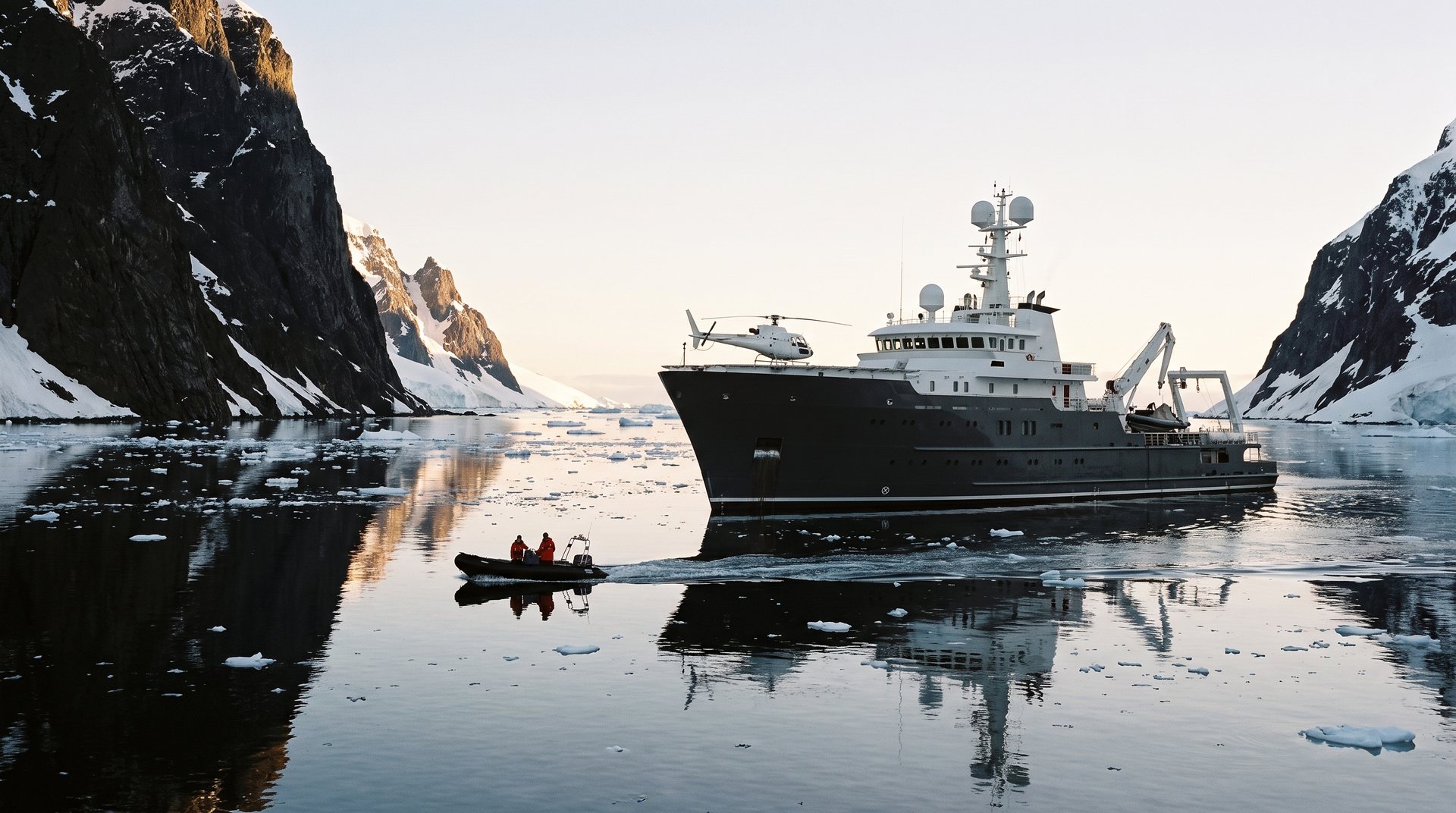
Explorer yachts. The world's remote coasts, with your own crew, tenders and timetable.
Explorer yachts are built for range, weather and self-sufficiency rather than for a berth in Monaco. They are how a family reaches Antarctica, Svalbard or the Kimberley with their own crew, their own tenders and nobody else's schedule.
What makes a yacht an explorer
Range, stores and a stronger hull
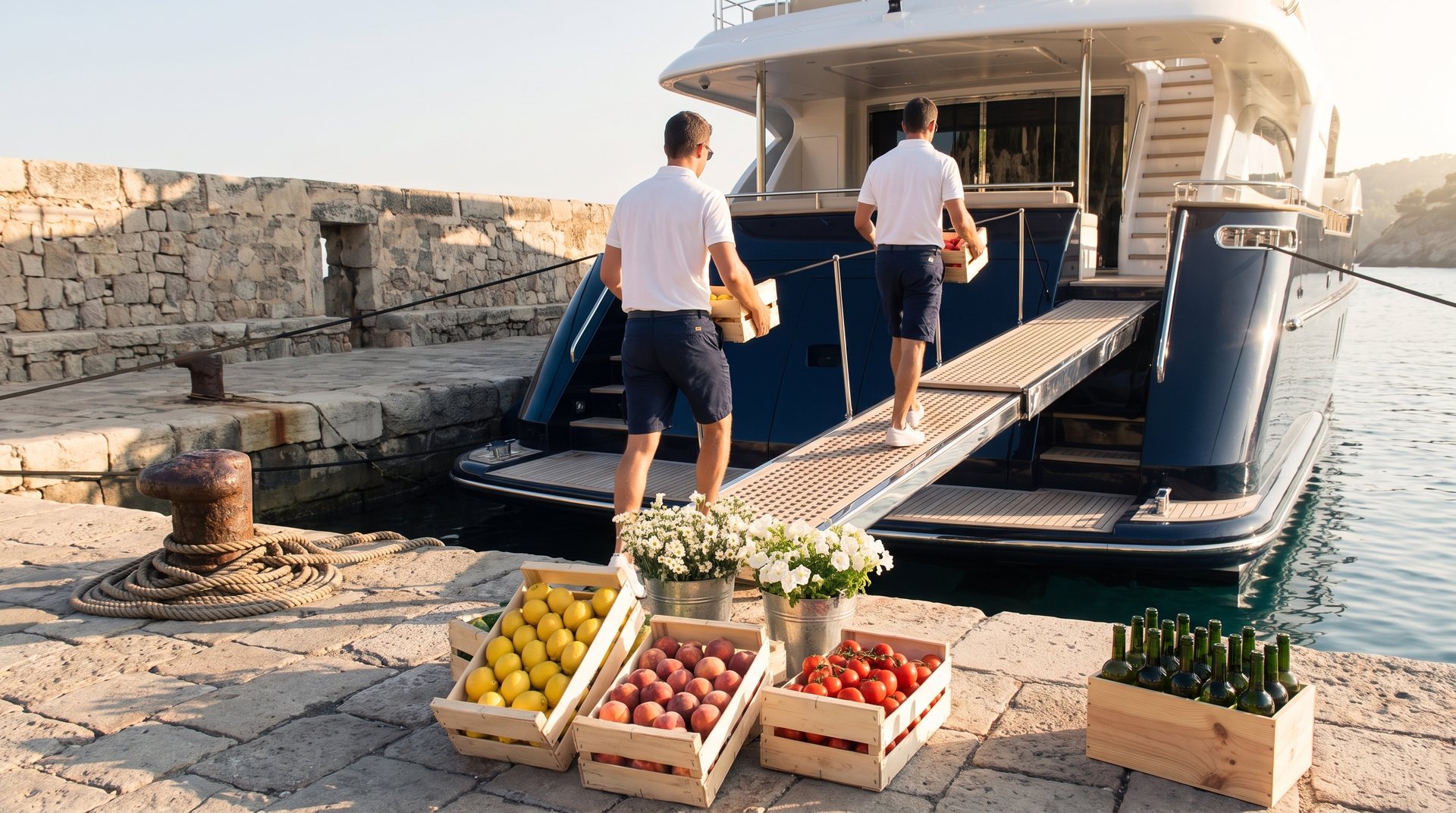
An explorer yacht is designed around distance from help. That means fuel and fresh water for thousands of miles rather than hundreds, cold stores and dry stores for weeks of provisioning, workshops and spares, redundant systems, and a hull built heavier than a Mediterranean yacht of the same length. For polar work it means an ice strengthened or ice classed hull and a crew who have used it.
The rest of the specification follows the same logic. Large tenders capable of carrying guests to shore in a swell rather than across a flat bay. A crane that can launch them in real conditions. Dive compressors and a dive store. Kayaks, snow machines or a submersible, depending on where she is going. A helicopter deck on some yachts, for a machine that either lands and stays or touches down and leaves, which are two very different certifications.
Some of these yachts began life as working vessels and were converted. Others are purpose built and look it. What they share is that the itinerary comes first and the marble comes second, which is precisely why people charter them.
Where they go
Seasons that cannot be argued with
| Region | Season | What decides the plan |
|---|---|---|
| Antarctic Peninsula | Roughly November to March | Voyages generally start from Ushuaia in Argentina or Punta Arenas in Chile, and cross the Drake Passage, about 800 nautical miles of open water each way. Visits must be authorised through the flag state or national authority under the Antarctic Treaty, and most serious operators work to IAATO guidelines. |
| Svalbard and the high Arctic | Roughly June to August | Longyearbyen at about 78 degrees north is the base. Ice, not the calendar, sets how far north and east a yacht gets in any given summer, and the plan is written to be changed. |
| Greenland | Roughly July to September | The west coast fjords, with ice charts read daily. Distances between settlements are long and fuel is where the settlements are. |
| Norwegian fjords and Lofoten | Roughly May to September | The gentlest introduction to this kind of cruising, with proper harbours, short hops and a yacht that does not need ice class. |
| Patagonia and the Chilean channels | Roughly November to March | Spectacular, sheltered in places and genuinely remote. Chilean waters bring their own pilotage and reporting requirements for visiting yachts. |
| The Kimberley, north west Australia | Roughly April to September | The dry season. Tidal ranges here are among the largest anywhere, which governs when a tender can reach a river mouth and when it cannot. |
| Raja Ampat and eastern Indonesia | Roughly October to April | Diving at the centre of the Coral Triangle. Foreign flagged yachts need Indonesian cruising permits, arranged well ahead. |
| Galapagos | All year, with two distinct seasons | The most administratively demanding destination of all. Visiting yachts need Ecuadorian permits and a licensed naturalist guide on board, numbers are limited, and applications take months. |
Seasons are the practical windows operators work to, not guarantees. In polar regions the ice and the weather decide the itinerary, and a good expedition captain will change it without apology.
What an expedition charter involves
Different from a week in the Med
- Lead times measured in months and sometimes a year, because the yacht has to be in that hemisphere in that season and everything is booked around it
- Permits, cruising licences and national park fees that belong to the destination rather than the yacht, several of which have to be applied for in a fixed order
- An expedition team on top of the yacht's crew: an ice pilot, a naturalist, a dive supervisor or a guide, depending on the region
- Running costs that are dominated by fuel and provisioning, so the advance provisioning allowance on an expedition charter is usually a larger share than on a Mediterranean week
- An itinerary written as intentions rather than promises, with the captain's judgement final on where the yacht actually goes each day
- Charter terms that deal properly with weather, ice and cancellation, which we go through with you before anything is signed
- Serious thought given to how far the yacht is from help, and what the operator's plan is if somebody needs to leave in a hurry
How it works
From an idea to a departure
- 01
The conversation
Where, roughly when, how many of you, and what you actually want to do: dive, climb, ski from the deck, photograph wildlife, or simply be somewhere nobody else is.
- 02
The shortlist
Yachts that will genuinely be in that region in that season, with the range, the ice capability and the toys the plan needs. We are blunt about which ones are genuinely capable of it.
- 03
Permits and people
The permissions for the region, the expedition team, and the flights. This takes the longest, so we start it first.
- 04
Getting you there
Flights to the departure port, hotels either side and the cars at every end. One person here holds the whole itinerary, so a delayed connection is our problem rather than yours.
The yachts
Roughly by size
Category guidance. What matters on an expedition is range, hull strength, tender capability and crew experience rather than length alone.

30 to 50 metres
Small expedition yachts
Capable, nimble and able to use small anchorages. Enough range for Norway, the Kimberley and Indonesia. Polar work at this size needs a yacht specifically built for it.

50 to 80 metres
The usual expedition size
Range, stores, a proper tender complement and room for an expedition team as well as guests. Most serious high latitude charters sit here.

Above 80 metres
Long range and helicopters
Submersibles, certified helicopter decks, a large expedition team and the ability to stay out for a very long time. Few yachts, booked far ahead.
Getting there
The flights are half the planning
Expedition departure ports are a long way from London, and most of them need more than one sector. Ushuaia is reached through Buenos Aires, Punta Arenas through Santiago, Longyearbyen through Oslo or Tromso, the Kimberley through Broome, Raja Ampat through Sorong, and the Galapagos through Quito or Guayaquil with a further flight to the islands.
Private charter shortens this, and on some of these routings it can save most of a day, but it does not make a twelve thousand mile journey into a short one. We plan it as a whole: the long sector, the regional sector, a night either side where the schedule deserves it, and cars and hotels that mean the family arrives able to enjoy the first day rather than sleeping through it. See on demand charter and ultra long range jets.
Where this connects
Related pages
Getting there
Gentler waters
Request a proposal
Tell us where and when
The region, the season you have in mind, how many of you and what you want the days to involve. We come back with yachts that will genuinely be there, the permits the plan needs and an honest view of the lead time. Nothing is booked or charged online.
Prefer to talk? +44 2030 048300 or WhatsApp, at any hour.
Questions people ask
About expedition charter
How far ahead do we need to plan?
Months, and for Antarctica or the Galapagos often a year. The yacht has to be in the right hemisphere for that season, and permits have their own calendars. Late enquiries are not impossible, but the choice narrows quickly.
Can we go to Antarctica on any large yacht?
No. The Antarctic needs a yacht built or strengthened for ice, a crew who have done it and the correct authorisation through her flag state. A Mediterranean superyacht painted dark grey is not an expedition yacht and we will say so.
Are these yachts uncomfortable?
Not at all. The good ones are as well finished as any charter yacht, with a spa, a proper galley and a chef. They simply spend their engineering budget on range and hull rather than on the beach club.
Who guides us ashore?
An expedition team carried for the charter: a guide or naturalist, a dive supervisor where there is diving, and in polar regions an ice pilot. They are arranged as part of the charter, not assumed.
What if the ice or the weather closes the plan?
The itinerary changes and the captain decides. That is normal in these regions and it is written into the agreement. Anyone who promises you a fixed itinerary at 78 degrees north is selling you something they cannot deliver.
Is it more expensive than a Mediterranean charter?
Usually, and mostly because of fuel, provisioning, permits and the expedition team rather than the yacht herself. We set the whole cost out before you commit. See what a charter costs.
One contact, wherever you are