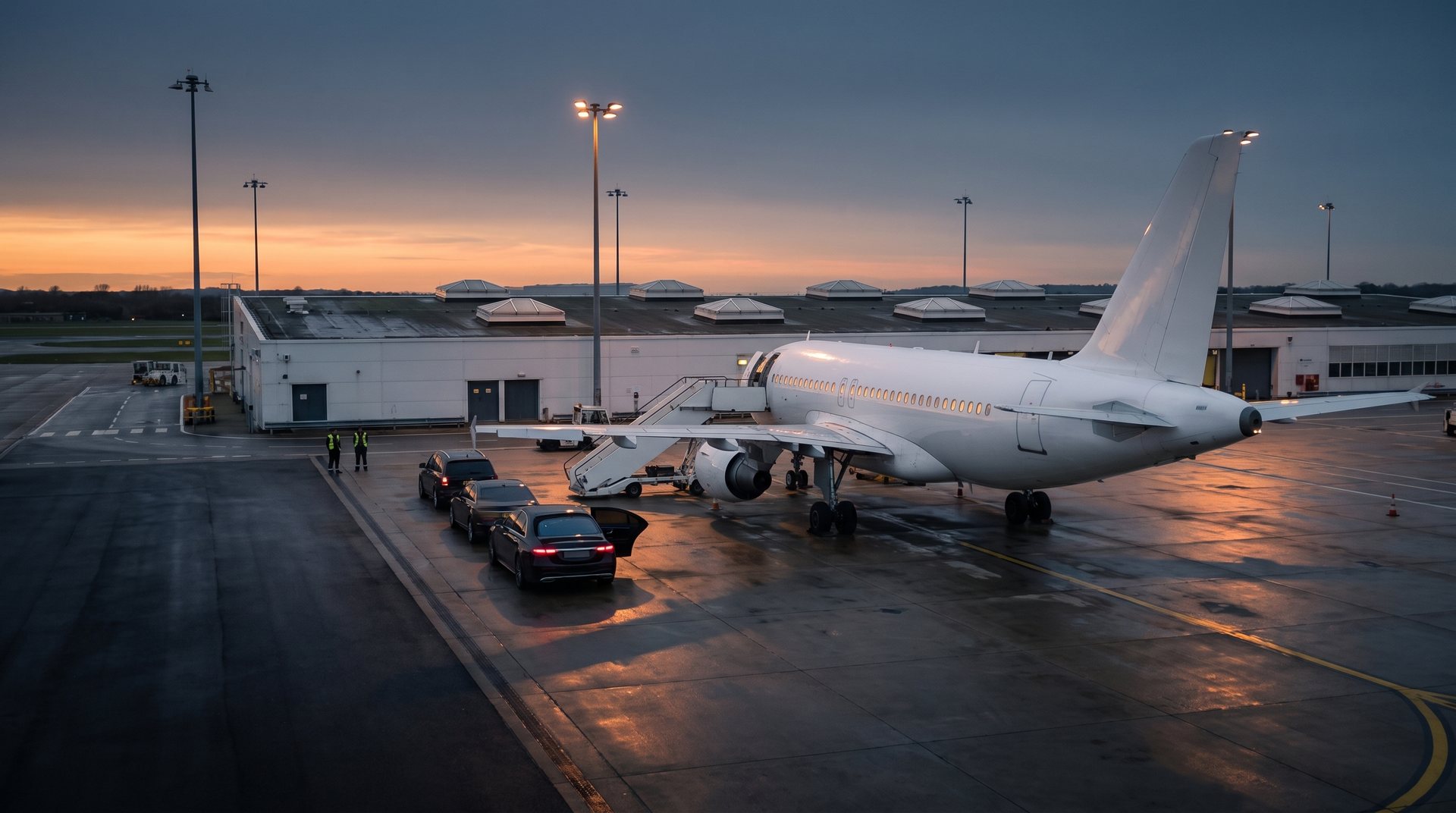
VIP airliners. When the party is bigger than any business jet.
A squad and its staff. A touring production. A delegation of forty. At that size the answer is not a larger business jet but an airliner, arranged and configured for the group.
PassengersFrom about 19 to 100 or moreA true VIP conversion usually carries around 19 to 50 people with room to spare. Beyond that, an airliner in a premium or all-economy layout is the honest answer.
RangeRoughly 3,000 to 6,700 nautical milesA VIP narrowbody can reach the Gulf, the eastern United States and much of Asia non-stop. An airline aircraft chartered as it stands will usually have less.
CabinZones, not rowsStanding height throughout, separate lounges, a dining or conference area, bedrooms and a shower on the most complete conversions, and a full galley with cabin crew.
HoldFreight, not suitcasesThe reason touring parties use them. Kit, instruments, equipment cases and team baggage go in a hold designed for cargo containers.
Category guidance. Figures are typical for the class rather than promises about a particular aircraft, and every quote names the actual aeroplane and its layout.
What it is for
Above sixteen people, the ladder stops
Business jets stop being the sensible answer at around sixteen passengers. A group of thirty in two heavy jets means two crews, two arrival times and two sets of handling, and it usually costs more than one airliner. The moment a squad, a cast, a touring crew or a delegation reaches that size, the conversation changes from which jet to which airliner and what layout.
There are really two things being described by the same phrase. The first is a VIP conversion: an Airbus or Boeing narrowbody fitted out with lounges, a conference area, bedrooms and cabin crew, carrying perhaps nineteen to fifty people in enormous space. The second is an airliner chartered in something close to its normal layout, which is what most sports and touring work actually uses, because ninety people need ninety seats, a hold for the kit and a schedule that fits the fixture list.
Both are arranged with licensed commercial operators, and both are quoted as a specific aircraft with a specific cabin. We will not describe a VIP conversion and deliver a charter aircraft with rows of seats.
Examples
Aircraft you are likely to be offered
Aircraft
Typical VIP seats
Typical range
Character
Airbus ACJ319neo
About 19 to 25
Around 6,750 nm
The long-legged VIP narrowbody. London to the American west coast or much of Asia non-stop
Airbus ACJ320neo
About 19 to 25, more in a group layout
Around 6,000 nm
A longer cabin than the 319 for the same width, which is where the bedrooms and second lounge go
Boeing BBJ MAX 8
About 19 in VIP form, up to about 50 in a group layout
Around 6,690 nm
The Boeing equivalent, with a slightly narrower cabin and comparable reach
Airbus A319, A320 and Boeing 737 in airline layout
Around 100 to 180
Shorter, and route dependent
What most squads and touring parties actually fly on, with a premium cabin fitted at the front
Regional jets such as the Embraer E190
Around 70 to 100
Shorter sectors
Useful where the airfield or the group is too small for a full narrowbody
Published range figures assume a light load. A full cabin, a freight hold and a winter headwind all reduce them, which is why the trip is planned on the actual date.
Range on the map
Where the class reaches
Drawn from Farnborough as true circles on the globe. The solid ring is the top of the class's typical range and the dashed ring is what most of its aircraft can plan on. Change the departure to see the reach from anywhere.
Published range85%, still-air planning
VIP airliners from Farnborough Airport (FAB). The solid ring is the top of the class's published range, 6,700 nautical miles; the dashed ring is 85% of the bottom of it, 2,550 nautical miles, which most aircraft in the class can plan on non-stop. Winds, payload and reserves reduce real range, so every trip is checked on the day.
Said honestly
What decides these charters
Airports, not aircraft. An airliner needs a runway, a stand, steps or an airbridge and somewhere to park between sectors, which rules out many of the small fields a business jet uses
Parking is often the binding constraint at a major event. An aircraft that drops a squad and leaves is a different plan, and a different cost, from one that waits three days
Slots and curfews decide departure times at busy airports far more than your schedule does
Crew duty hours are a hard limit. A long sector with a late arrival and an early departure may need a second crew, which has to be planned rather than discovered
Customs and immigration for forty or ninety people is an operation in itself, and is arranged in advance with the handling agent at both ends
Lead time is measured in weeks for the best aircraft on a fixture date, not days. Tours and tournaments book the same aircraft as everybody else
The aeroplane is usually the easy half. A squad landing at eleven at night with kit bags, a medical team and a police liaison needs vehicles positioned before the aircraft is on stand, a route that works for a convoy rather than a car, and one person who knows where everybody is. That is the work we do alongside the charter rather than after it.
In London and Manchester those vehicles are our own cars with our own chauffeurs. Everywhere else they are arranged through operators we know and briefed to the same plan. For a group movement we set out the whole schedule in one document: who is on which vehicle, where it waits, who the chauffeur reports to and what happens if the aircraft is two hours late. See group and delegation travel for how that is put together.
Go a size down
When two business jets are better
Between about seventeen and thirty passengers the arithmetic is genuinely close.
Groups that split naturally into two travelling parties
Airfields an airliner cannot use at one end
Schedules where half the group leaves a day earlier
Shorter sectors where an airliner's advantages do not show
Type the two ends of the trip, and the number travelling if you know it. You will see the distance, a realistic time in the air, and which classes and aircraft can fly it without a stop, with this class marked.
Distances are great circle, the shortest line over the earth. Non-stop is judged against 85% of each aircraft's published still-air range, which leaves a sensible margin for reserves, wind and load. Times are a planning range for the time in the air, not a schedule. Aircraft are arranged with licensed commercial operators, and every quote is checked against the actual aircraft, the load and the forecast for your date.
Request a quote
Tell us the group and the fixture list
How many people, how much freight, the dates and whether the aircraft waits or returns empty. For a tour or a season, send the whole schedule rather than one leg: aircraft, parking and crew are planned across the run, not sector by sector. Nothing is booked or charged online.
We arrange the charter with a licensed commercial operator and tell you which aircraft, which layout and which operator before you commit. On the ground, our own cars and chauffeurs cover London and Manchester and elsewhere vehicles are arranged through operators we know, briefed to the same movement plan.
How many people before an airliner makes sense?
Usually somewhere between seventeen and thirty, depending on the sector and the freight. Below that, one or two heavy jets are normally better. We quote both when it is close.
Can we carry the kit as well as the people?
That is often the reason for the aircraft. The hold takes equipment cases, instruments and team baggage that no business jet could. Give us the weights and dimensions and they are planned into the load.
Can it land at our nearest airport?
Sometimes, and often not. Runway length, stand availability, parking and the airport's own restrictions decide it, and we check them for your date rather than assuming. Where the answer is no, we plan the road leg from the nearest suitable airport.
Will it be a proper VIP cabin?
Only if that is what is quoted and available. Many group charters fly on airline aircraft with a premium cabin at the front, which is perfectly comfortable and not the same thing. We describe the actual layout, with a plan of it, before you commit.
How far ahead should we ask?
Weeks rather than days for a fixture date, a festival or a tournament. Everybody wants the same aircraft on the same weekend, and the aircraft that suits your group is a small list.