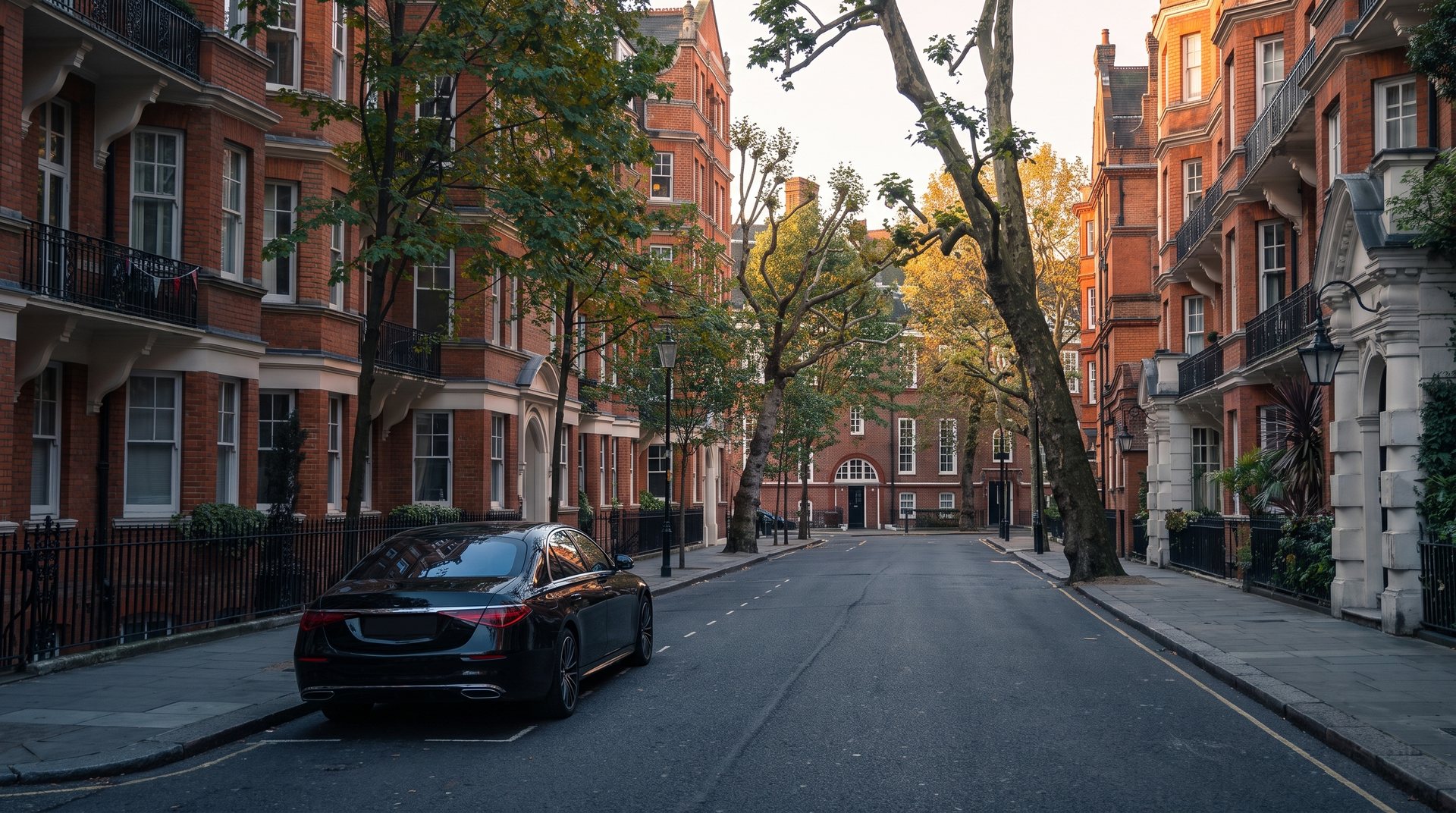
London private hospitals. The right door on the way in, and a car that waits to take you home.
The hospitals are spread from St John's Wood to London Bridge, and our chauffeurs know the entrance and the kerb at each one. On the day you go home, the car is held from the morning rather than booked for a time.
- 20+years in private travel
- Ownedchauffeur fleet in London and Manchester, a trusted global network beyond
- 24/7operations desk, one contact
- 3services on one itinerary: car, jet and yacht
In partnership with Harrods Aviation · Signature Aviation · SW Global
The map
Five clusters, not one district
People talk about Harley Street as though every private bed in London were on it. The consulting rooms largely are, and we have a separate page about Harley Street and Marylebone. The hospitals themselves sit in five loose groups, and the group matters more than the postcode when you are working out what time a car should leave.
Marylebone holds the largest concentration. The London Clinic occupies the block between Harley Street and Devonshire Place and looks out onto Marylebone Road. King Edward VII's Hospital is on Beaumont Street, The Princess Grace Hospital on Nottingham Place, The Harley Street Clinic on Weymouth Street and The Portland Hospital on Great Portland Street. All of them are within a few minutes' walk of one another and none of them has a kerb you can park at.
North of the park, The Wellington Hospital sits at Wellington Place in St John's Wood, just off the Wellington Road, a short distance north of Lord's. West, The Cromwell Hospital is at 164 to 178 Cromwell Road in South Kensington, on the main road out towards the M4. South of Hyde Park Corner, Cleveland Clinic London is at 33 Grosvenor Place in Belgravia, and The Lister Hospital is on Chelsea Bridge Road by the Royal Hospital. Across the river, London Bridge Hospital is at 27 Tooley Street, tucked between the railway viaduct and the Thames.
The kerb
Where a car can actually stop
| Hospital | Where it is | What the arrival is like |
|---|---|---|
| The London Clinic | Between Harley Street and Devonshire Place, facing Marylebone Road | Set down at the entrance, then the chauffeur waits a few streets away. The one way pattern means the return leg is a loop rather than a reverse |
| King Edward VII's Hospital | Beaumont Street, Marylebone | A narrow, quiet street with permit bays. Fine for a set down, impossible for a wait |
| The Princess Grace Hospital | Nottingham Place, Marylebone | Residential and tight. Tell us if imaging or day surgery uses a different door from the main one |
| The Portland Hospital | Great Portland Street | A busy two way road with bus traffic. Worth arriving a few minutes early rather than circling |
| The Wellington Hospital | Wellington Place, St John's Wood | The calmest of them for a car. Side streets nearby take a waiting vehicle without drama, and the district is outside the Congestion Charge zone |
| The Cromwell Hospital | Cromwell Road, South Kensington | A fast main road with restrictions along much of its length. The quieter approach is from the streets behind rather than the A4 itself |
| Cleveland Clinic London | Grosvenor Place, Belgravia | On the Hyde Park Corner gyratory. The set down works; waiting anywhere near it does not |
| The Lister Hospital | Chelsea Bridge Road, Chelsea | Sits on a bridge approach that moves quickly. We time arrivals away from the school run on Chelsea Bridge |
| London Bridge Hospital | Tooley Street, Southwark | The tightest of the group. Tooley Street is narrow, busy and full of buses, and the chauffeur will usually hold on the Bermondsey side |
Described from working the streets rather than from any traffic order, and written as planning guidance. Kerbside rules change. The chauffeur's habit is always the same: set down at the door, wait legally nearby with the car, come back when you say.
The two days that matter
Admission is a time. Discharge is a guess
Admission days run to the letter. You are given an hour, you arrive a little before it, and the car is gone twenty minutes later. The only real questions are which entrance, how much luggage and whether anybody is coming with you.
Going home is the opposite. Discharge times slip by two or three hours as a matter of routine, and the car booked for eleven is the car you cannot get back at half past two. The arrangement that works is to hold the car from a point in the morning rather than to book it for a time, which is what hourly and as directed means in practice. The chauffeur waits, the phone is answered on the first ring, and nobody is standing in a lobby with a bag.
For a stay of any length, most people settle on the same chauffeur throughout. It saves explaining the entrance, the lift and the side door twice a day for a fortnight. See dedicated chauffeur, and after a procedure for how the journey home itself is handled.
Worth telling us
The five things that change the plan
None of it is clinical and none of it is our business. It is simply what a chauffeur needs in order to be in the right place.
- The entrance. Several of these buildings have one door for outpatients, another for admissions and a third for imaging, sometimes on different streets
- Whether the car should wait or be released. On a discharge day, hold it. On an outpatient appointment, hold it as well: consulting rooms run late far more often than they run early
- Who else is travelling, and whether they arrive separately. A relative, a companion, an interpreter or a nurse travels as an ordinary passenger
- Luggage, honestly counted. A week's admission generates more of it than people expect, and it decides whether an S-Class or a V-Class is sent
- Whether anything about the arrival should be quieter than usual: no name spoken at the door, a side entrance, or the car held out of sight of the main steps
Getting there
Typical journey times to the hospital districts
| From | Marylebone and St John's Wood | Kensington, Belgravia and Chelsea | London Bridge |
|---|---|---|---|
| Heathrow | 45 to 100 minutes | 40 to 90 minutes | 55 to 110 minutes |
| Luton | 50 to 105 minutes | 60 to 110 minutes | 60 to 110 minutes |
| Farnborough | 60 to 125 minutes | 55 to 110 minutes | 70 to 130 minutes |
| London City | 30 to 75 minutes | 35 to 80 minutes | 25 to 55 minutes |
| Northolt | 30 to 70 minutes | 30 to 70 minutes | 45 to 90 minutes |
| Biggin Hill | 55 to 115 minutes | 50 to 105 minutes | 40 to 85 minutes |
| St Pancras, from Eurostar | 10 to 30 minutes | 20 to 45 minutes | 20 to 40 minutes |
The lower figure is quiet roads, the higher one a normal busy period. Realistic ranges for planning, not promises. We set the departure time from the hour of the appointment, with a margin, and we watch the actual arrival of a flight rather than the printed one.
Charges and zones
What the car deals with for you
Marylebone is inside the Congestion Charge zone. St John's Wood, Kensington and Chelsea are outside it. The Ultra Low Emission Zone covers the whole of Greater London at every hour of every day. All of that is handled as part of the journey rather than being something for anyone to think about on the morning of an admission.
Arriving from abroad, the chauffeur meets you inside the terminal on a scheduled flight and waits out the delay, which is described on meet and greet. Arriving privately, the car goes to the terminal on the field and the chauffeur coordinates with the handling agent: see private terminal transfers. If you are booking on somebody else's behalf, private hospitals and patient offices is written for you.
Our part in the stay
The car and the chauffeur, from admission to home
We provide the car and the chauffeur for the admission, the appointments and the journey home, with the waiting taken care of. We are not a medical or ambulance service, so we bring no medical staff or equipment, give no clinical care or advice, and neither work with nor recommend any hospital, clinic or consultant named here.
Around the trip
Related pages
In London
Request a quote
Tell us the address and the hour
The collection address, the hospital and entrance, the time you have been given and whether the car should wait. Nothing about the reason, please, and we will not ask. We reply with a clear price and confirm the chauffeur in writing. Nothing is booked or charged online.
Prefer to talk? +44 2030 048300 or WhatsApp, at any hour.
Questions people ask
About hospital journeys in London
Do you have a relationship with any of these hospitals?
None. We are not a partner or a supplier to any of them. They are named here as places a car is asked to go, and we recommend none of them.
Is this a medical service?
No. It is a chauffeur service: a car to the right door and a chauffeur who waits. We bring no medical staff or equipment and give no care, supervision or advice; if a journey needs clinical support, a medical provider is the right choice. See clinic and hospital transfers for the full statement.
Can the car wait outside the entrance?
Almost never, and nowhere in Marylebone. The chauffeur sets you down at the door, waits legally a few streets away with the car, and returns to the same door when you send word. Send it as you leave the ward rather than when you reach the pavement.
Will the hospital appear on our invoice?
Not unless you want it to. We can describe a journey by area, or by a reference you choose. See security and discretion.
Can you take someone home after a stay?
Yes, and it is worth reading after a procedure first, because the way that journey is driven and timed is different from an ordinary transfer.
Are these your own cars?
Yes. Our own cars and chauffeurs are in London and Manchester, and a trusted global network covers everywhere else. Here in London that means the same chauffeur can cover a whole admission and discharge.
One contact, wherever you are